

By Baltimore Counseling Center | Last updated: November 2026
The best lifestyle for an adult with ADHD is built on regular movement, protected sleep, predictable meals, structure that lives outside your head, and care with alcohol and cannabis. These habits make daily life easier and support treatment, but they do not replace it.
Below, each habit is checked against current research, followed by a simple weekly template and places to start in Baltimore. If you are looking for therapy and coaching options as well, see our guide to managing ADHD in adults without medication.
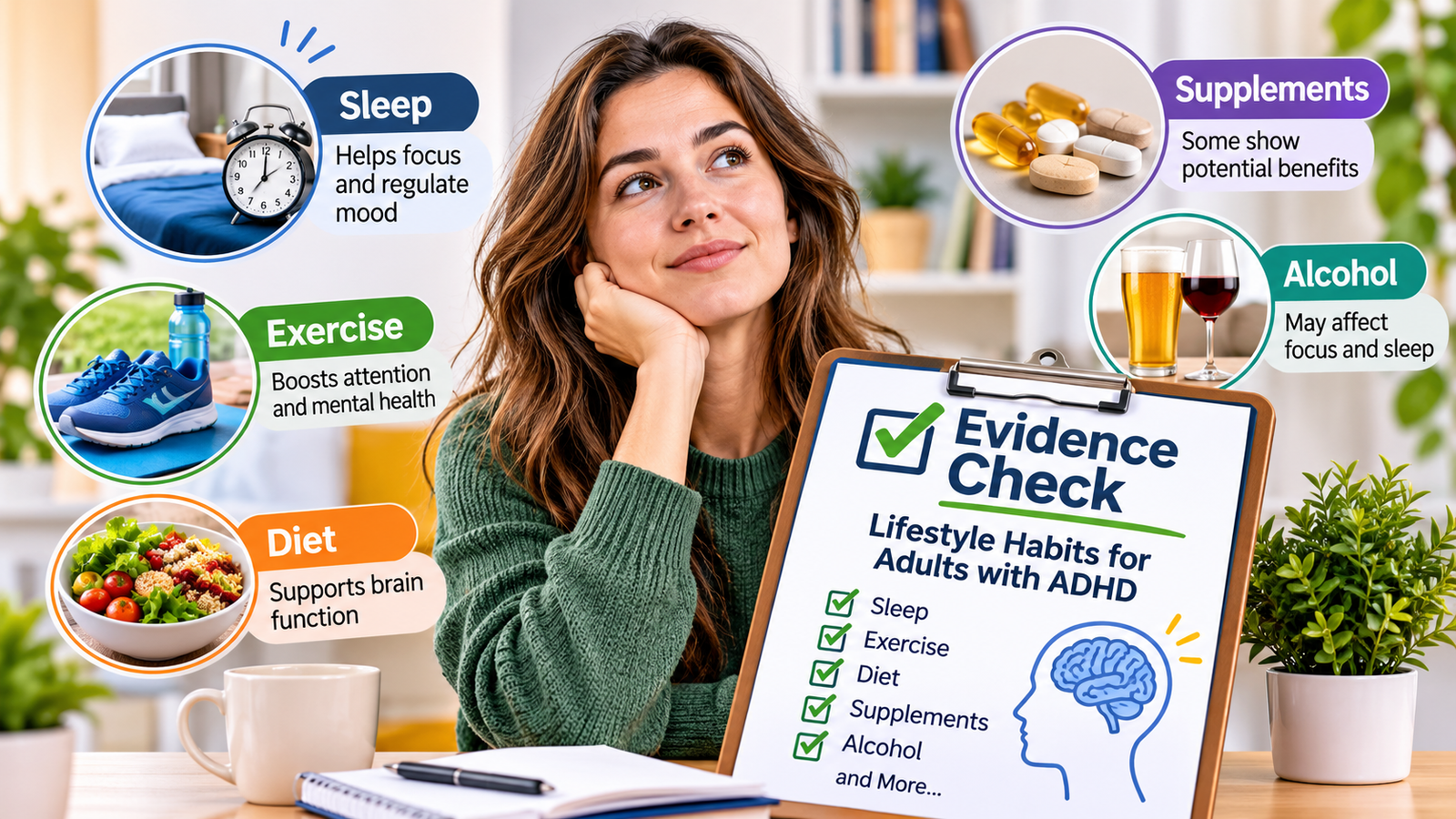
The Evidence Check: Which Habits Help Adults With ADHD Most?
Regular movement and good sleep have the strongest support among lifestyle habits for adults with ADHD. Special diets and supplements have the weakest evidence, and alcohol and cannabis carry real risks. The table sums up what the research shows.
Habit | What research in adults shows | Strength of evidence |
Regular movement | Reviews published in 2026 found small but consistent symptom improvements after single exercise sessions. The studies were small. | Moderate |
Sleep | Sleep problems affect up to 70% of adults with ADHD, and poor sleep makes focus and mood harder. | Strong link |
Meals and diet | No specific diet has been shown to treat adult ADHD. Regular meals support steady energy and routine. | Limited |
Omega-3 and supplements | A 2023 review of randomized trials found no significant improvement in core symptoms overall. | Weak |
Time outdoors | Nature exposure is linked to fewer ADHD symptoms, but most studies involve children. | Limited in adults |
Alcohol and cannabis | Substance use disorders are far more common in young adults with ADHD. | A risk to manage |
Structure outside your head | Organizing and planning skills are a core part of CBT programs built for adult ADHD. | Practical and widely recommended |
The strength ratings reflect our reading of the sources cited in each section, not a formal grading system. Lifestyle changes work best as one part of an ADHD plan, alongside therapy and, for some people, medication.
Move Your Body Most Days
Regular movement is one of the best-supported lifestyle habits for adults with ADHD. Even a single exercise session has been linked to small improvements in symptoms, so short, frequent movement matters more than an intense plan you cannot keep.
A 2026 meta-analysis of studies in adults with ADHD found small but consistent improvements in core symptoms after single exercise sessions (Psychology of Sport and Exercise, 2026). A separate 2026 review also found a small but significant drop in symptoms after short bouts of activity (Abo Akademi University). Both note that the studies were small, so the size of the benefit is still uncertain.
There is no ADHD-specific exercise amount. A sensible target is the general US guideline: at least 150 minutes of moderate activity a week, such as 30 minutes on 5 days, plus muscle-strengthening activity on 2 days (CDC). Shorter bouts count, so a few 10-minute walks still add up.
Ways to make movement stick:
- Take a 10 to 20 minute walk before work or before a task that needs focus.
- Put workouts in your calendar like appointments, at the same time each day.
- Choose something you enjoy, such as a sport, a class, cycling or dancing, so it does not depend on willpower.
- Go with a friend or join a group. Someone expecting you makes it easier to show up.
Protect Your Sleep
Sleep is one of the most important parts of an ADHD lifestyle, because sleep problems are common with ADHD and make every symptom harder. A fixed wake time and daylight soon after waking are the simplest places to start.
According to the National Institute of Mental Health, sleep problems affect up to 70% of adults with ADHD (NIMH). Many adults with ADHD are “night owls”: research has linked adult ADHD with a body clock that runs later than usual (Expert Review of Neurotherapeutics, 2013). A review of sleep treatments for adults with ADHD found six studies, and three of them supported morning light therapy (Surman and Walsh, 2021). Talk to a health care provider before trying a light box.
Most adults need at least seven hours of sleep a night, according to the American Academy of Sleep Medicine. Yet a CDC data brief published in May 2026 found that 30.5% of US adults slept less than that in 2024 (KPBS/NPR, 2026).
Sleep habits that help:
- Wake up at the same time every day, including weekends.
- Get outside or near a bright window within the first hour of waking.
- Set a “screens off” alarm 30 to 60 minutes before bed.
- Keep caffeine to the morning or early afternoon.
- Charge your phone outside the bedroom if late-night scrolling is a pattern.
Why Do People With Unmedicated ADHD Feel Tired All the Time?
Many adults with ADHD feel tired because they sleep poorly or too late for their schedule, often because their body clock runs late. Ongoing fatigue can also come from an untreated sleep disorder or from depression, which commonly occurs alongside ADHD, so it deserves a check-up.
Sleep disorders such as insomnia, restless legs, sleep-disordered breathing and circadian rhythm disorders are common in people with ADHD but are often not assessed or treated (Nature and Science of Sleep, 2018). This can happen whether or not someone takes ADHD medication. If you feel tired most days despite a steady sleep routine, ask a provider about a sleep evaluation.
Eat in a Way That Is Easy to Repeat
No special diet has been proven to treat adult ADHD, so the goal is meals that are regular and simple enough to repeat. Predictable eating supports steady energy and makes the rest of your routine easier to keep.
ADHD can make it harder to plan meals and easier to eat on impulse or while distracted. A health trust in Northern Ireland suggests simple fixes, such as serving a portion into a bowl and leaving the packet in the kitchen, and making snacks harder to reach (Belfast Health and Social Care Trust).
Habits that make eating easier:
- Set phone reminders for meals if you tend to forget to eat when focused.
- Keep one reusable grocery list and order the same staples each week.
- Have three or four go-to meals that need no planning.
- Keep water where you work so you drink without thinking about it.
Do Vitamins or Omega-3 Help Adults With ADHD?
The evidence is weak. A 2023 review of randomized trials with 1,789 participants found that omega-3 supplements did not significantly improve core ADHD symptoms compared with placebo, though the authors said long-term use may deserve more study (Journal of Clinical Psychiatry, 2023).
That review included both children and adults. Research on other vitamins and minerals for adult ADHD is limited. Talk to a health care provider before starting any supplement, especially if you take other medicines.
Alcohol, Cannabis and Caffeine
Adults with ADHD are more likely to develop problems with alcohol and cannabis, so it helps to be honest with yourself about how much you use and why. Substances can feel helpful in the moment but usually make sleep, focus and mood worse over time.
In a Canadian study, half of adults aged 20 to 39 with ADHD had had a substance use disorder at some point, compared with 23.6% of those without ADHD. Alcohol use disorder was the most common, followed by cannabis (University of Toronto, 2021). The researchers noted that untreated depression and anxiety can push people to self-medicate.
Practical steps:
- Notice when you reach for alcohol or cannabis to calm down, sleep or “turn off” your brain. That is a sign to look for other support.
- Avoid alcohol close to bedtime, since it can disrupt sleep.
- If you use caffeine to get going, keep it to the morning or early afternoon.
- If substance use worries you, talk to a provider. For free, confidential treatment referrals, call the SAMHSA National Helpline at 1-800-662-4357.
Get Outside in Daylight
Spending time outside in daylight is a low-cost habit that supports your sleep schedule and pairs naturally with exercise. Research linking nature to fewer ADHD symptoms comes mostly from children, so treat it as a helpful habit rather than a treatment.
Studies summarized by CHADD found that children with more exposure to nature were less likely to have ADHD or had milder symptoms (CHADD, 2021). There is far less research in adults. Still, morning daylight helps anchor your body clock, and a walk outside counts toward your movement for the day.
Easy ways to add daylight:
- Take your first coffee or phone call outside.
- Walk part of your commute or park farther away.
- Eat lunch outdoors when the weather allows.
- Plan one longer outdoor activity each weekend.
Build Structure Outside Your Head
ADHD makes it hard to hold plans in memory, so the most useful habits move reminders, time and tasks into your surroundings. Start with one small change, attach it to something you already do, and make the cue impossible to miss.
Habits take longer to form than the popular “21 days” suggests. Studies have found it can take anywhere from 4 to 335 days (ADDA). An article in CHADD’s Attention magazine advises changing one habit at a time and keep your motivation visible (CHADD, 2022). Organizing and planning skills are also a core part of CBT programs built for adult ADHD.
Effective Hacks for Adults With ADHD
The most effective hacks lower the effort needed to start and make the next step obvious. These habit-building hacks work alongside the time and task tools in our guide to managing adult ADHD without medication.
Hack | How to use it |
Attach new habits to old ones | “After I pour my coffee, I check today’s calendar.” |
Make the cue impossible to miss | Leave your gym bag by the door or your water bottle on your desk. |
Shrink the start | Do a two-minute version: one email, one load of laundry, five minutes of walking. |
Use if-then plans | “If I get home from work, then I change into walking shoes.” |
Hold a weekly reset | Spend 30 minutes each Sunday clearing your desk and checking the week ahead. |
Reward yourself right away | Pair a dull task with music, a podcast or a favorite drink. |
Track a streak | Mark each day you do the habit on a wall calendar. Missing one day is fine; avoid missing two. |
If you get stuck before you even start, our guides to the three types of ADHD paralysis and getting out of ADHD shutdown can help.
Relationships, Rest and Support
Supportive relationships and real rest make every other habit easier to keep. Tell the people close to you what helps, plan downtime on purpose, and connect with others who understand ADHD.
ADHD can strain relationships through missed plans, forgotten tasks or emotional reactions that feel bigger than the moment. Naming what helps you, such as written reminders or a heads-up before plans change, turns frustration into a shared system. Peer groups are another source of practical ideas. CHADD runs local chapters and online support communities for adults (CHADD).
Rest matters too. Schedule unstructured time each week so you are not running on empty, and protect it the same way you protect appointments.
Tips for Dealing With Someone Who Has ADHD
Focus on shared systems instead of blame. Agree on one family calendar, put important requests in writing, and talk about what is working at a calm time rather than in the middle of a conflict.
- Split tasks by strengths instead of splitting them evenly.
- Use visual tools, such as a whiteboard by the door, for chores and plans.
- Notice and name what is going well, not only what slipped.
- Consider couples or family therapy if the same conflicts keep repeating.
Your ADHD-Friendly Week: A Simple Template
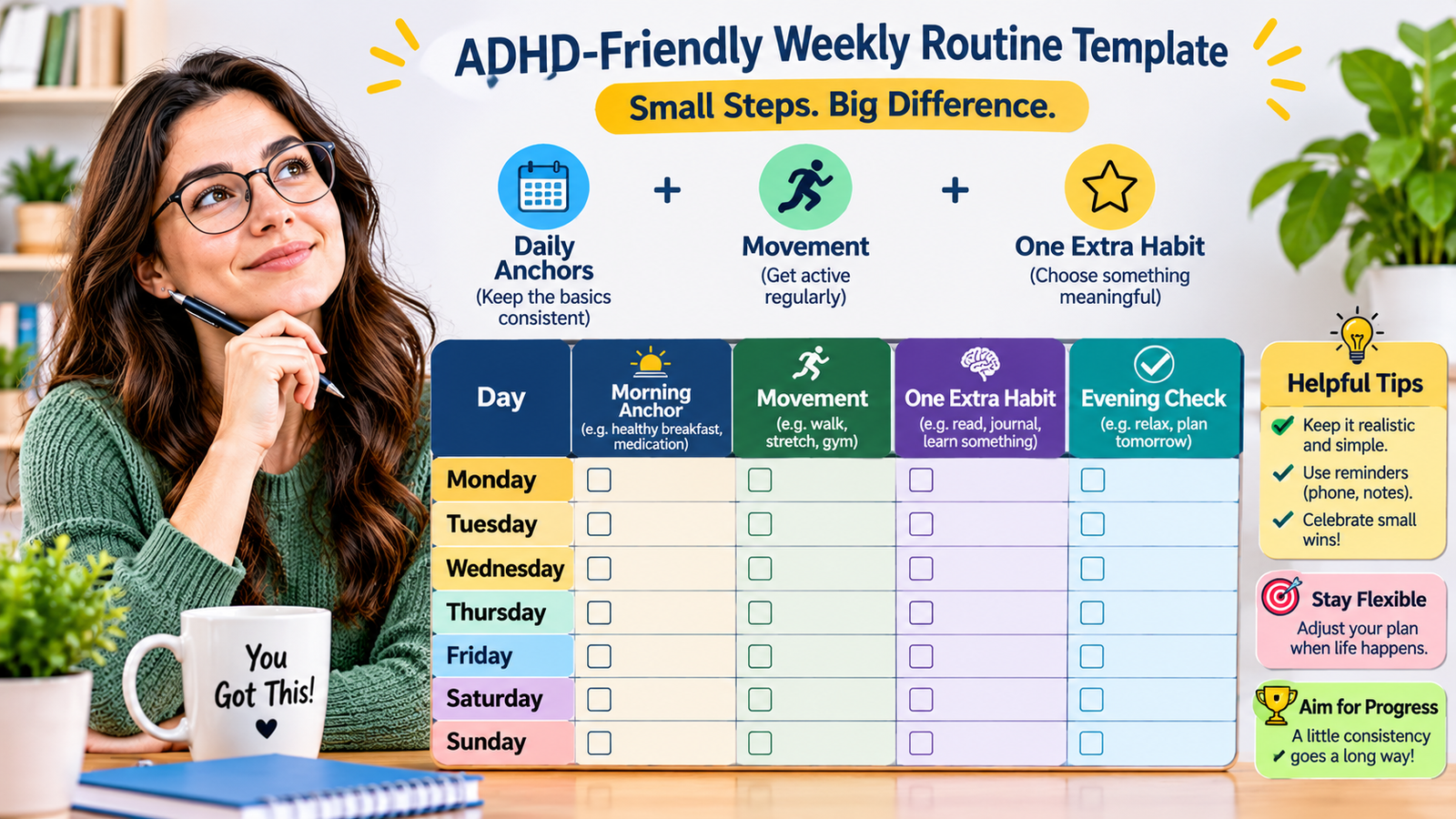
A good ADHD week has a few fixed anchors and plenty of room for flexibility. Use this template as a starting point and adjust the times to fit your life.
Day | Daily anchor | Movement | One extra habit |
Monday | Same wake time, daylight within an hour | 20-minute walk before work | Check the week’s calendar |
Tuesday | Same wake time, daylight within an hour | Short stretch or walk at lunch | Place the grocery order from your repeat list |
Wednesday | Same wake time, daylight within an hour | Walk, class or sport | Midweek check: what slipped, what to drop |
Thursday | Same wake time, daylight within an hour | Short walk | 30-minute admin block for bills and email |
Friday | Same wake time, daylight within an hour | Walk or bike ride | Plan one social activity |
Saturday | Wake within an hour of your usual time | Longer outdoor activity at a park or trail | Free time with no plans |
Sunday | Same wake time, daylight within an hour | Light stretch | 30-minute weekly reset and simple meal prep |
Keep the anchors steady even when the rest of the week falls apart. If a week goes badly, restart on Monday with just the wake time and one walk.
Where to Start in Baltimore
Baltimore has free places to walk and get daylight, local ADHD peer groups, and professional support if you want help building these habits. Pick one from each list below and add it to your calendar this week.
Places to move and get outside
- Baltimore has more than 4,000 acres of parkland, including Druid Hill Park and Patterson Park (Baltimore City Recreation and Parks).
- The Gwynns Falls Trail links more than 30 neighborhoods in west and southwest Baltimore with parkland (Gwynns Falls Trail).
- The Jones Falls Trail runs from Druid Hill Park to the Inner Harbor (City of Baltimore).
- Baltimore City Recreation and Parks runs guided hikes and bike rides. Check its outdoor recreation page for current dates.
People who understand ADHD
- Maryland has CHADD chapters in Greater Baltimore, Anne Arundel County and Montgomery County. Use the CHADD chapter locator to find current meetings.
Professional support
- Baltimore Counseling Center offers ADHD testing in Baltimore and Maryland, therapy, and ADHD coaching for adults focused on time management and organization.
- Remote sessions and evening and weekend appointments are available. Our office is at 703 Dale Ave, Baltimore, MD 21206.
When Lifestyle Changes Are Not Enough
If you have kept steady habits for a few months and still struggle at work, at home or in relationships, it is time to talk to a professional. Lifestyle changes support ADHD care, but they are not a substitute for an evaluation or treatment.
Consider reaching out if:
- Missed deadlines, late bills or lost items keep causing serious problems.
- You feel anxious, low or hopeless most days. ADHD often occurs alongside anxiety and mood disorders (NIMH).
- You rely on alcohol, cannabis or other substances to cope.
- You are not sure whether what you are dealing with is ADHD. Our article on adult ADHD or anxiety explains the differences.
For therapy, coaching and other options, read our guide to managing ADHD in adults without medication. If you take ADHD medication, do not stop or change it without talking to your prescriber.
If you are in crisis or thinking about harming yourself, call or text 988 to reach the 988 Suicide and Crisis Lifeline, or call 911 in an emergency.
About Baltimore Counseling Center
Baltimore Counseling Center is a mental health practice in Baltimore, Maryland. Our team includes licensed clinical social workers (LCSW-C), licensed master social workers, licensed graduate professional counselors and psychiatric mental health nurse practitioners (PMHNP).
We offer ADHD testing, therapy for adults, ADHD coaching and medication management, in person at 703 Dale Ave, Baltimore, MD 21206, and through remote sessions. Contact us to schedule an appointment.
Frequently Asked Questions
What is the best lifestyle for someone with ADHD?
How do you thrive with adult ADHD?
What are some healthy habits for adults with ADHD?
Can lifestyle changes replace ADHD medication?
Do vitamins help adults with ADHD?
Key Takeaways
- Regular movement and steady sleep have the strongest support among lifestyle habits for adult ADHD.
- No diet or supplement has been shown to treat adult ADHD, so aim for regular, easy-to-repeat meals.
- Alcohol and cannabis problems are more common with ADHD; notice if you use them to cope.
- Build structure outside your head and add one habit at a time; habits can take months to form.
- Lifestyle supports treatment but does not replace it. If habits are not enough, talk to a professional.
