
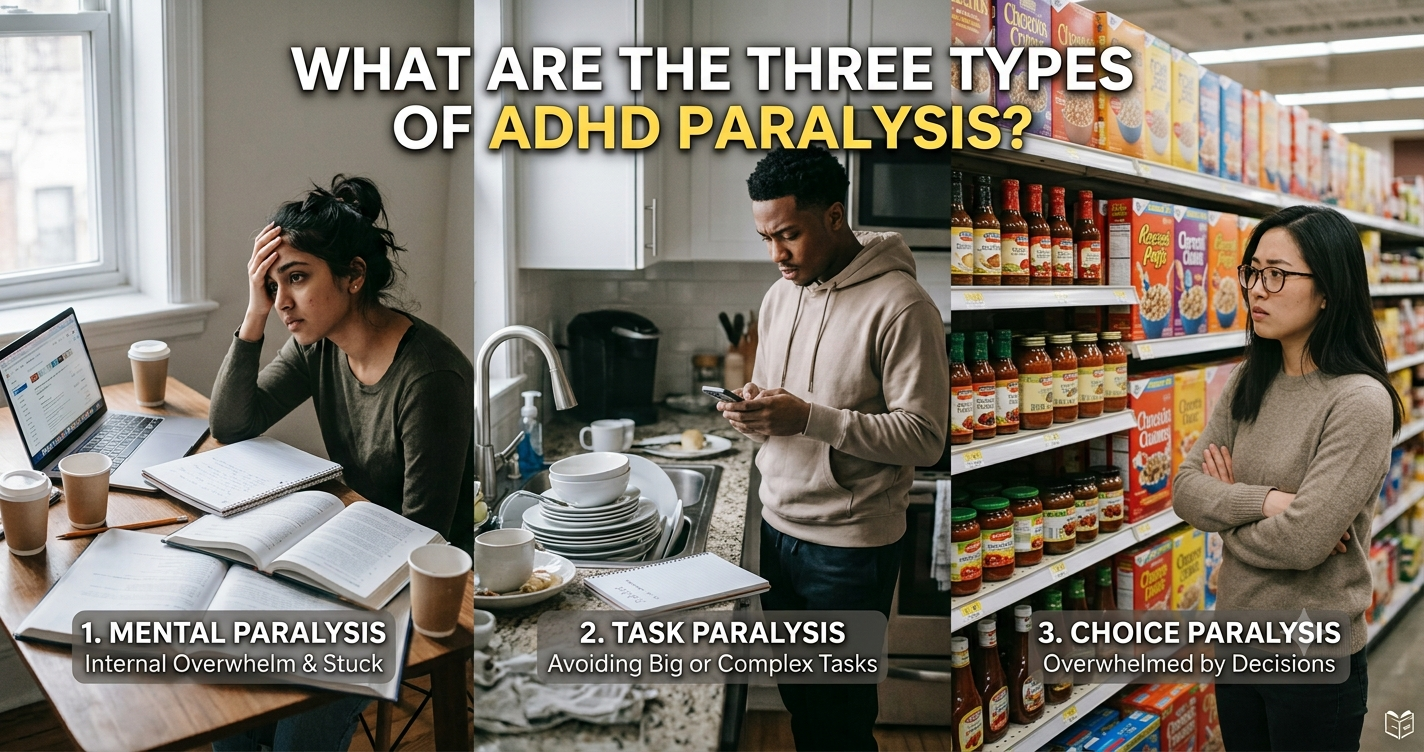
The three types of ADHD paralysis are mental paralysis, choice paralysis, and task paralysis. Mental paralysis is a mental shutdown caused by emotional or sensory overload. Choice paralysis is the inability to pick between options. Task paralysis is the inability to start or finish a task, even one you want to do. All three come from executive dysfunction, not laziness.
ADHD paralysis is not an official diagnosis. It is a descriptive term for a real experience: your brain hits a wall and refuses to move, no matter how much you want it to.
The Three Types at a Glance
Type | What It Feels Like | Common Triggers | Everyday Example | Helpful Coping Strategy |
Mental paralysis | Brain fog, total shutdown, “my mind went blank” | Emotional stress, sensory overload, too much information at once | Freezing mid conversation during a heated argument at work | Step away, lower stimulation, use grounding techniques |
Choice paralysis | Stuck between options, decision fatigue, fear of choosing wrong | Too many options, unclear priorities, perfectionism | Spending 40 minutes scrolling a menu app, then ordering nothing | Limit options to two or three, set a decision deadline |
Task paralysis | Wanting to start but physically unable to begin | Boring tasks, vague instructions, large projects, deadlines | Staring at an unopened tax folder for three weekends in a row | Break the task into a five minute first step |
What ADHD Paralysis Actually Is
ADHD paralysis is a freeze response tied to executive dysfunction, where overwhelm shuts down your ability to think, decide, or act. The term does not appear in the DSM-5, the manual clinicians use to diagnose mental health conditions.
So why do therapists, ADHD coaches, and educators use it anyway? Because it names something patients describe constantly: “I sat on the couch for two hours knowing I needed to leave.” The three types are educational categories, not clinical ones, and they help people recognize their patterns and match each with the right strategy.
Therapist Insight “Many people describe ADHD paralysis as wanting to move but feeling mentally stuck. In session, we treat it as an executive function challenge, not a motivation problem, and that shift alone lowers shame.”
ADHD by the Numbers
Verified statistics from authoritative sources:
- About 6 percent of U.S. adults, roughly 15.5 million people, have a current ADHD diagnosis (CDC, 2024)
- More than half of adults with ADHD were diagnosed in adulthood (CDC)
- An estimated 2 to 5 percent of adults worldwide experience ADHD symptoms (CDC/MMWR)
- 47 percent of adults with ADHD also met criteria for an anxiety disorder, and 38 percent for a mood disorder (National Comorbidity Survey Replication, Kessler et al., 2006)
- 84.5 percent of adults with a current ADHD diagnosis are under age 50 (CDC)
One honest caveat: no organization tracks “ADHD paralysis” as its own statistic, because it is a descriptive term. The numbers above measure the conditions underneath it.
Executive Dysfunction, Explained Simply
Executive dysfunction means the brain’s self management system is not working smoothly. Executive functions are the mental skills that let you plan, prioritize, start tasks, hold information in working memory, manage time, and regulate emotions.
Think of them as the conductor of an orchestra. The musicians, meaning your knowledge, skills, and motivation, may all be excellent, but if the conductor is distracted, the music falls apart. That is why someone with ADHD can be brilliant, motivated, and completely stuck at the same time.
Why ADHD Paralysis Happens
ADHD paralysis happens when demands on the brain’s executive system exceed its capacity, triggering shutdown instead of action. Several ingredients usually combine: overwhelm from too many inputs at once, low dopamine drive that stalls task initiation, working memory limits that make big tasks feel shapeless, emotional flooding that swamps thinking, and time blindness that makes deadlines feel distant until they suddenly feel impossible. The freeze that follows mirrors the freeze part of the fight, flight, or freeze response.
The ADHD Paralysis Cycle
Most freeze episodes follow the same loop:
Overwhelm
|
Executive dysfunction
|
Freeze (mental, choice, or task paralysis)
|
Avoidance
|
Shame
|
More overwhelm (the cycle repeats)
Breaking the loop at any point, usually by shrinking the next step, stops the spiral.
What Research Says
Research on the executive functions behind ADHD paralysis is extensive, though the term itself is informal. In plain English:
Executive function. Decades of research, much of it led by psychologist Russell Barkley, frame ADHD as a disorder of self regulation, not a simple attention problem. The gap is between knowing and doing.
Dopamine. Imaging studies show differences in dopamine signaling within reward and motivation pathways, which explains why interest, novelty, and urgency can spark action when importance alone cannot.
Working memory. Adults with ADHD score lower on average on working memory tasks, so multi step projects overload that capacity and trigger freezes.
Task initiation. Studies tie initiation problems to those motivation circuits, not to ignorance of consequences. People freeze fully aware of what is at stake.
Emotional regulation. Researchers increasingly recognize emotional dysregulation as a core feature of ADHD. Strong emotions narrow thinking capacity, which sets up the shutdowns described below.
Type 1: Mental Paralysis
Mental paralysis is a cognitive shutdown where thinking itself stalls, usually under emotional or sensory overload. People describe it as brain fog or going blank.
Picture a college student in Baltimore sitting down for a final exam. She knows the material, but pressure floods her system, and when she reads the first question, nothing comes. Overwhelm has taken her executive functions offline. Mental paralysis often appears during conflict, criticism, chaotic environments, or after long stretches of masking ADHD symptoms.
Type 2: Choice Paralysis
Choice paralysis, sometimes called analysis paralysis, is the inability to decide between options. Each option opens a branching tree of possibilities, and the ADHD brain tries to evaluate all of them at once. Because prioritizing is itself an executive function, choosing an insurance plan and choosing lunch can feel equally heavy.
A real world example: a professional needs to reply to three job recruiters. Each reply requires small decisions about tone and timing. Days pass, and all three opportunities quietly expire. The choosing, not the wanting, was the barrier. Perfectionism pours fuel here: if anything short of the best choice feels like failure, your brain treats deciding as a threat and refuses to engage.
Type 3: Task Paralysis
Task paralysis is knowing exactly what you need to do and being unable to start. It is the type most people mean when they search for ADHD paralysis, and the one most often mislabeled as laziness.
Difficulty starting spikes when a task is boring, vague, long, or emotionally loaded. Laundry, taxes, emails, and big projects are classic culprits. This is why so many people with ADHD freeze right before starting work: the transition into a task demands more executive effort than the task itself.
Here is what it can look like: a parent plans to clean the kitchen after the kids are in bed. She stands there, phone in hand, fully intending to start. Ninety minutes later she has not moved, now flooded with shame on top of the overwhelm. That loop matters, because paralysis feeds on itself: the longer the freeze lasts, the bigger the task feels, and the deeper the freeze becomes.
Therapist Insight “The clients who break out of task paralysis fastest are rarely the ones trying hardest. They are the ones who make the first step smallest.”
Symptoms: How ADHD Paralysis Shows Up
The most common signs are an inability to start tasks, mental blankness under pressure, endless deliberation, and shutdown behaviors like scrolling or staring. Others include:
- Feeling physically heavy or stuck when trying to begin
- Jumping between low priority activities while avoiding the main one
- Racing thoughts paired with zero action
- Losing track of hours during a shutdown, then a wave of shame afterward
If several happen regularly and interfere with work, school, or relationships, the pattern deserves professional attention, not more self blame.
ADHD paralysis also looks different across ages. Children more often show it as homework refusal, meltdowns during transitions, or apparent “ignoring” of instructions. Adults tend to shut down quietly and mask the struggle, one reason so many are diagnosed late.
Common Triggers
The biggest triggers are overwhelm, unclear expectations, too many choices, emotional stress, and fatigue. In our Baltimore practice, clients most often name:
- Large projects with no defined first step
- Inboxes and to do lists that have piled up
- Being watched or evaluated while working
- Transitions, like returning to work after a break
- Sensory chaos: noise, clutter, interruptions
Sleep deprivation deserves special mention: even one short night reduces executive functioning, and ADHD brains start with less reserve, so freezes often cluster after poor sleep. Most people discover two or three repeat offenders, and planning around them prevents a large share of episodes.
ADHD Paralysis, Anxiety, Depression, Burnout, and Perfectionism
ADHD paralysis rarely travels alone. Co-occurring conditions lengthen freeze episodes, and emotional dysregulation sits underneath many of them: when feelings spike faster than the brain can process, the freeze takes over.
Anxiety can make ADHD paralysis worse. It adds threat signals to an already overloaded system, so a task becomes a chance to fail publicly. In the NCS-R study, nearly half of adults with ADHD also had an anxiety disorder.
Therapist Insight “ADHD paralysis can absolutely happen without anxiety, because it comes from executive dysfunction itself. When anxiety is present, though, freezes tend to run longer and feel more punishing, so we screen for both.”
Depression drains the motivation and energy task initiation depends on. When low dopamine drive meets low mood, even basic self care can freeze.
Burnout lowers executive capacity across the board. Many adults with ADHD run on overdrive to compensate, and when that reserve runs out, paralysis spikes.
Perfectionism turns starting into a risk. If the result must be flawless, the safest move your brain can find is not starting at all. Yes, ADHD paralysis is directly linked to perfectionism for many high achievers.
ADHD Paralysis vs. Procrastination: What’s the Difference?
The difference is choice. Procrastination is a decision to delay a task, and it responds to willpower and deadlines. ADHD paralysis is an involuntary freeze driven by executive dysfunction, and willpower alone often cannot break it.
A useful test: how does the delay feel? Procrastination usually brings relief, at least at first. ADHD paralysis brings distress: you are trapped inside the avoidance, criticizing yourself the entire time. That is why “just set a deadline” advice fails, while executive functioning strategies, covered next, work.
Myth vs. Fact
Myth | Fact |
ADHD paralysis is just laziness. | It is a freeze response linked to executive dysfunction, and it happens to motivated, capable people. |
ADHD paralysis is an official diagnosis. | It is a descriptive term. The underlying executive function challenges are well documented in ADHD research. |
People can snap out of it if they try harder. | Pressure and shame usually deepen the freeze. Structure and support break it. |
Only children have ADHD symptoms like this. | Adult ADHD is common, and many adults are diagnosed after age 18. |
Medication is the only thing that helps. | Medication helps many people, and therapy, coaching, and lifestyle changes add real, measurable benefit. |
How to Get Out of ADHD Paralysis: Evidence Based Strategies
The fastest way out is to shrink the demand: pick one tiny action, lower the stakes, and reduce open decisions. These strategies come from cognitive behavioral approaches and executive functioning research:
Use the five minute rule. Commit to five minutes with permission to stop after. Starting is the broken switch, so make the start absurdly small.
Break tasks into visible steps. “Do taxes” is shapeless. “Find last year’s W-2” is a step working memory can hold. Write steps down.
Cut your options. For choice paralysis, force a shortlist of two or three and set a timer. A good enough choice today beats a perfect choice never.
Externalize time. Timers, alarms, and visual schedules counter time blindness.
Regulate first, act second. If you are emotionally flooded, no trick will land. Breathe slowly, move for a few minutes, then return to the smallest next step.
Lower the shame. Talk to yourself the way you would talk to a friend who froze. Shame is not fuel. It is another trigger.
Therapist Insight “Body doubling, meaning working alongside another person in the room or on a video call, helps because it borrows regulation from another nervous system. It is a legitimate clinical strategy, not a crutch.”
Treatment Options That Actually Help
The most effective treatment combines therapy, skills training, and, for many people, medication, tailored to how ADHD shows up in your life.
Therapy. A therapist who understands adult ADHD helps you untangle the freeze pattern from the shame wrapped around it, and treats co-occurring depression or anxiety.
Cognitive behavioral therapy (CBT). CBT adapted for ADHD is one of the best studied approaches for adults. It targets thoughts that feed paralysis, like all or nothing thinking, and builds planning, prioritizing, and task initiation skills.
ADHD coaching. Coaching builds day to day systems: calendars, routines, accountability, and environment design. It pairs well with therapy rather than replacing it.
Medication. Stimulant and non stimulant medications improve attention and task initiation for many adults, and freezes often shorten once medication is dialed in. These decisions belong with a prescribing clinician.
Lifestyle strategies. Consistent sleep, regular movement, and steady meals protect executive capacity. None cure ADHD, but running on empty makes every symptom worse, and paralysis flares first.
Signs It May Be Time to Seek Professional Support
It may be time to seek support if freeze episodes are frequent, distressing, or costing you real opportunities. Check the signs that apply:
- Paralysis episodes happen weekly or more
- Deadlines, bills, or appointments regularly slip because you cannot start
- You lose hours to shutdowns and cannot account for the time
- Shame after a freeze affects your mood for days
- Anxiety or low mood is growing alongside the shutdowns
- You recognize yourself here but have never had an ADHD assessment
Checking two or three of these is reason enough to talk with a professional.
For adults, students, and parents in the Baltimore area, Baltimore Counseling Center offers ADHD focused therapy, including CBT and executive functioning support, with licensed Maryland clinicians. A proper evaluation can also identify conditions that mimic or amplify ADHD paralysis, because the right diagnosis shapes the right plan.
Key Takeaways
- ADHD paralysis is a freeze response caused by executive dysfunction, not laziness.
- It is not a DSM-5 diagnosis. It is a descriptive term for a well documented experience.
- The three types: mental paralysis (thinking shuts down), choice paralysis (deciding shuts down), task paralysis (starting shuts down).
- Anxiety, depression, burnout, poor sleep, and perfectionism make episodes longer and more frequent.
- Small first steps, fewer choices, and external time cues are the fastest ways out.
- Therapy, CBT, coaching, medication, and lifestyle changes work best combined.
Frequently Asked Questions
Executive dysfunction. When tasks, choices, or emotions exceed the brain’s capacity to plan, prioritize, and initiate, the system freezes. Low dopamine signaling, limited working memory, emotional flooding, and time blindness contribute.
The experience is real, but the term is informal and not in the DSM-5. It describes executive dysfunction, a well researched feature of ADHD that clinicians take seriously.
Procrastination is a voluntary delay that usually brings relief. ADHD paralysis is an involuntary freeze that brings distress: you want to act and cannot.
Shrink the demand: one five minute step, fewer choices, a timer, and a calm body first. Long term, therapy, coaching, and medication reduce episode frequency.
Yes. Anxiety adds threat to an already overloaded system, which deepens the freeze. Treating both together works better than treating either alone.
Episodes range from minutes to hours, and stuck patterns around one task can stretch across weeks, depending on stress, sleep, and co-occurring conditions.
For many adults, yes. Medications improve attention and task initiation, which often makes freezes shorter and less frequent. They work best paired with therapy.
Summary
ADHD paralysis is the freeze that happens when executive dysfunction meets overwhelm. The three types, mental, choice, and task paralysis, are educational labels rather than diagnoses, but they map a real experience shared by millions of adults. The way out is never more shame. It is smaller steps, fewer decisions, and the right support.
If freeze episodes are shaping your work, studies, or home life, you do not have to untangle this alone. Baltimore Counseling Center provides ADHD assessments, therapy, and executive functioning support for adults, college students, and families across Baltimore, Maryland. Reach out to schedule a confidential consultation and take the first small step, the only one that matters today.
