
Adult ADHD and anxiety get confused because several of their symptoms look the same from the outside. Trouble concentrating, restlessness, poor sleep, and difficulty keeping up with everyday responsibilities can show up in both. They are still different conditions, and what separates them is usually the pattern: when the difficulties started, how consistent they are across different parts of life, and what seems to be driving them.
That is why symptoms alone cannot settle the question. Two people can describe the same bad afternoon at work for completely different reasons. Sorting that out is a clinical judgement a qualified healthcare professional makes after an evaluation. What follows is educational information, not a diagnosis.
What Is the Difference Between Adult ADHD and Anxiety?
ADHD is a developmental disorder. The National Institute of Mental Health describes it as a persistent pattern of inattention and/or hyperactivity and impulsivity that makes it hard to function in at least two areas of life, such as home, school, or work. Symptoms must have begun before age 12, even when the diagnosis comes much later.
Anxiety disorders are a group of conditions in which fear or worry is excessive, persistent, and interferes with daily life. Anxiety disorders are a group of conditions rather than a single diagnosis. Their symptoms and diagnostic criteria vary. For example, generalized anxiety disorder (GAD) involves excessive, difficult-to-control worry occurring on most days for at least six months, along with other symptoms.
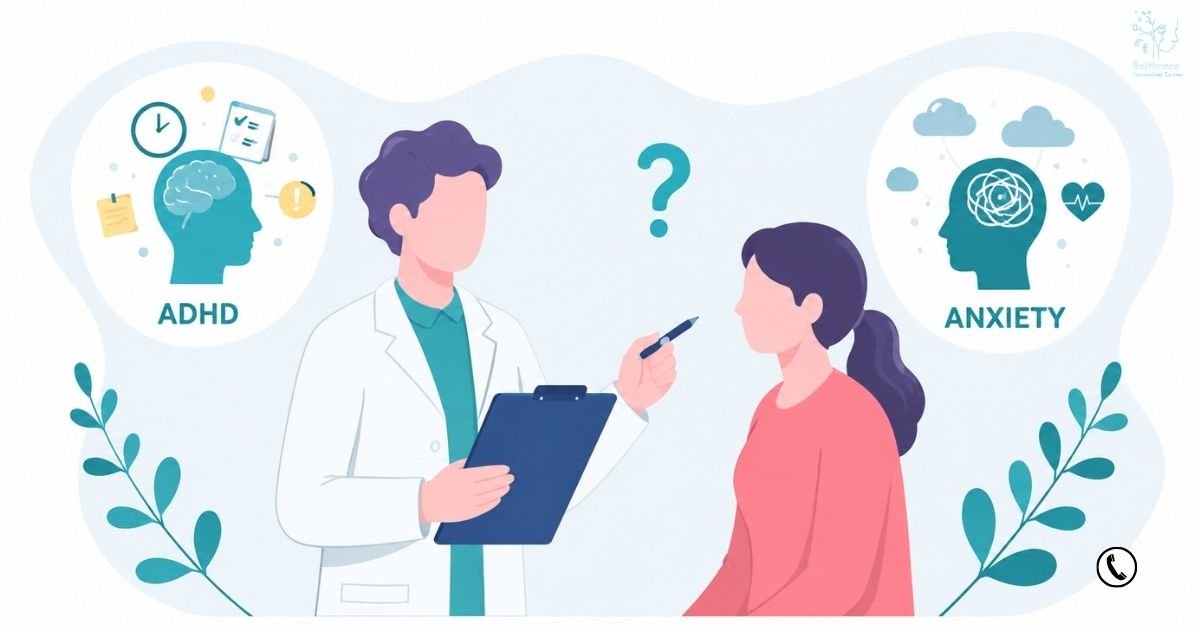
In plain terms: ADHD is a long-running pattern in how attention and self-regulation work, present since childhood. Anxiety centres on fear and worry that has become excessive or hard to switch off. One does not rule out the other.
Why Can ADHD and Anxiety Look So Similar?
Because a symptom describes what someone experiences, not why.
Take an adult who cannot get through a report at work. With ADHD, attention may drift off the task repeatedly, and starting may be the hardest part. With anxiety, the mind may be occupied by worry about the report, the deadline, or something else entirely, leaving little attention left over. From the outside, both look like a person staring at a screen and getting nothing done. The same is true of restlessness, poor sleep, and irritability. None of them point cleanly to one condition.
What Symptoms Can Overlap Between ADHD and Anxiety?
Seeing yourself in one or more of these experiences does not mean you have ADHD or an anxiety disorder. The table shows why the overlap causes confusion, not how to tell the two apart.
Symptom or experience | Can occur with ADHD | Can occur with anxiety | Why it can be confusing |
Difficulty concentrating | Yes. Inattention is a core feature. | Yes. It is a GAD symptom criterion. | Losing focus feels the same whether attention drifts or worry crowds it out. |
Restlessness | Yes. In adults, hyperactivity often shows up as internal restlessness. | Yes. Feeling restless or on edge is a GAD symptom. | Both get described as an inability to settle. |
Sleep problems | Common. NIMH reports these affect up to 70% of adults with ADHD. | Yes. Trouble falling or staying asleep is a GAD symptom. | Poor sleep worsens attention on its own. |
Trouble finishing tasks | Yes. Disorganisation and unfinished projects are typical. | Sometimes. Worry and avoidance can stall tasks. | The outcome looks identical. |
How Does Adult ADHD Typically Affect Attention and Daily Tasks?
ADHD in adults is better understood as a pattern than as a list. NIMH describes adult symptoms that can include getting distracted easily, disorganisation and procrastination, poor time management, forgetting daily tasks, losing things, trouble finishing projects, difficulty sitting still, restlessness, and choosing immediate rewards over future ones.
The qualifier matters more than the list. NIMH is explicit that many people show some of these behaviours some of the time. For adults with ADHD, they are more severe, more frequent, and more persistent, they occur across multiple situations, and they have lasted at least six months.
Symptoms also change with age. NIMH notes that inattentive symptoms often persist while hyperactivity and impulsivity are more likely to decline, and the CDC notes that hyperactivity in adults may appear as extreme restlessness.
How Can Anxiety Affect Concentration and Daily Functioning?
Anxiety can interfere with concentration because attention is being spent elsewhere. When worry is persistent and hard to control, it competes for the same mental resources a task needs.
NIMH describes adults with GAD as often highly nervous about everyday circumstances such as job performance, health, finances, family wellbeing, and household responsibilities. Alongside the worry, people may feel irritable or on edge, struggle to relax, have a hard time concentrating, and sleep poorly or feel fatigued. NIMH also notes that symptoms fluctuate and are often worse during stressful periods. That fluctuation is itself informative, and a clinician will ask about it.
What Clues Help Professionals Tell ADHD and Anxiety Apart?
No single symptom decides this. An evaluation weighs the whole picture.
1. When the difficulties began
ADHD is a developmental condition, so evidence of symptoms before age 12 matters. The CDC notes that a provider will work out whether symptoms were present before that age, and may ask permission to gather information from friends and family.
That does not mean ADHD is always identified in childhood. Diagnosis in adulthood is common: in CDC’s 2023 national survey data, an estimated 15.5 million U.S. adults had a current ADHD diagnosis, and about 56% received it at age 18 or older. NIMH points to reasons a diagnosis can come late, including symptoms not being recognised at the time, supportive environments that masked the difficulty, or a milder presentation that only became a problem under adult demands.
2. The pattern across situations
ADHD symptoms tend to show up across settings rather than in one corner of life, and NIMH’s description requires difficulty functioning in at least two areas. Anxiety-related difficulty may be more tied to specific worries, situations, or stretches of stress. That is a general tendency, not a rule that sorts individual cases.
3. What seems to be driving the difficulty
Clinicians explore what the experience is actually like. Is attention wandering off, or locked onto a worry? Is restlessness physical fidgeting, or does it come with dread? These descriptions are useful information rather than a test, and people often find their own experience hard to categorise.
4. The broader history
The CDC notes that a medical and psychological exam may be needed to rule out other health problems that can cause ADHD-like symptoms, or that often occur alongside ADHD, including anxiety, depression, sleep problems, alcohol or substance misuse, and learning disabilities.
Can Someone Have Both ADHD and Anxiety?
Yes. NIMH states that ADHD often co-occurs with other conditions, including anxiety and depression, and that this can make them harder to diagnose and treat. Having symptoms consistent with one does not rule out the other.
Published estimates of how often the two occur together vary widely by population and method, so no single figure should be treated as settled. What is clear is that co-occurrence is common enough that clinicians consider it rather than stopping at one explanation.
Why Is Self-Diagnosing ADHD or Anxiety Difficult?
Looking up your symptoms is reasonable, and it is often how people take the first useful step. The limitation is not curiosity. It is that a symptom list cannot capture what decides the question.
A checklist cannot establish when symptoms began, how long they have lasted, whether they occur across several settings, how much they interfere with functioning, or whether something else explains them. Difficulty concentrating, restlessness, fatigue, and disrupted sleep all have multiple possible contributors, including sleep disorders, thyroid and other medical conditions, medication effects, substance use, depression, and ordinary high-stress periods. Working through those is what an evaluation is for.
When Should an Adult Consider a Professional Evaluation?
There is no threshold you have to cross to be allowed to ask. It may be worth speaking with a professional when difficulties:
- have persisted rather than passing with a stressful stretch
- interfere with work or study
- affect relationships
- make everyday responsibilities hard to manage
- cause significant distress
- are difficult to make sense of on your own
NIMH’s guidance on anxiety is that when it starts causing problems in everyday life, it is time to seek professional help. For ADHD, the CDC’s advice is that the first step is talking with a healthcare provider, who may evaluate the symptoms themselves or refer you to a mental health provider.
What Can an ADHD or Anxiety Evaluation Involve?
This varies by provider and by what is being considered, but an evaluation may include:
- current symptoms, when they began, how long they have lasted, and their impact
- personal and mental health history
- childhood history and, where ADHD is being considered, information from people who knew you then, or school records
- how symptoms affect work, home life, and relationships
- relevant medical information, including a physical exam
- standardised rating scales or psychological tests where appropriate
- consideration of other conditions that could explain the picture
A questionnaire on its own does not establish a diagnosis. It is one input among several.
Adult ADHD vs. Anxiety: A Simple Takeaway
- ADHD: a persistent pattern of inattention and/or hyperactivity and impulsivity, beginning in childhood, that interferes with functioning in more than one area of life.
- Anxiety: excessive or persistent worry and fear, with related symptoms such as restlessness, trouble concentrating, and sleep problems, that interferes with daily life.
- Both: symptoms can overlap, and the two can occur in the same person.
These are summaries, not decision rules.
When Should You Talk With a Mental Health Professional?
If you are trying to work out whether attention difficulties, persistent worry, or both are affecting your daily life, talking with a qualified mental health professional can help you understand what you are experiencing and what support may be appropriate.
Baltimore Counseling Center is a mental health counselling practice in Baltimore, Maryland, working with adults. It offers individual therapy, couples therapy, group therapy, and medication management, and its service pages cover ADHD testing and treatment and anxiety therapy, with teletherapy available. It is a private practice, not a government agency or hospital, and the medical information above comes from NIMH and the CDC.
If you would like to talk it through, you can contact the team or book an appointment.
Frequently Asked Questions
Yes. The two share several symptoms, including difficulty concentrating, restlessness, irritability, and sleep problems, and those feel similar from the inside. Telling them apart depends on things a symptom list cannot capture, such as when the difficulties began and how consistent they are across settings.
Yes. NIMH notes that ADHD often co-occurs with other conditions including anxiety and depression, and that this can make both harder to diagnose and treat. Symptoms consistent with anxiety do not rule out ADHD, and the reverse is also true.
Not from symptoms alone. An evaluation considers when the difficulties began, whether they occur across multiple settings, how much they interfere with functioning, and what else could explain them. For ADHD, evidence of symptoms before age 12 is part of the picture. Only a qualified healthcare professional can make that determination.
Yes. Trouble concentrating is one of the symptoms in the diagnostic criteria for generalized anxiety disorder, alongside restlessness, fatigue, irritability, muscle tension, and sleep problems. Persistent worry competes for the attention a task needs. Concentration problems have other possible contributors too, including poor sleep.
The symptoms do, but the diagnosis does not. NIMH notes symptoms must have begun before age 12. Many people are not identified until adulthood: in CDC’s 2023 survey data, about 56% of U.S. adults with a current ADHD diagnosis received it at 18 or older.
Symptoms can become more noticeable as demands increase. The CDC notes ADHD symptoms may become more severe as adult demands grow, and NIMH notes anxiety symptoms are often worse during stressful periods. Stress alone also disrupts concentration and sleep in anyone.
