

You know exactly what you need to do. The task is right in front of you. But your brain simply will not move.
Maybe you are on the edge of your bed, staring at a to-do list you cannot start. The dishes and emails have piled up, and now you feel frozen. You are not being dramatic, and you are not lazy. You may be experiencing what many people call an ADHD shutdown.
If that phrase brings a wave of relief, you are not alone. Many adults, including people across Baltimore, quietly deal with this. This guide explains what ADHD shutdown is, why it happens, and the practical steps that help you move again, gently and without shame.
What Is ADHD Shutdown?
ADHD shutdown is a state of mental and physical “freeze” that happens when the ADHD brain becomes overwhelmed. A person knows what they want to do but cannot get themselves to start. It is closely linked to executive function and the body’s stress response, and it is not a sign of laziness.
“ADHD shutdown” is a term used widely by the ADHD community and by many clinicians. It is also called ADHD paralysis or ADHD freeze. It helps to know that shutdown is not a formal medical diagnosis the way ADHD itself is. Instead, it describes a real and common experience that people with Attention-Deficit/Hyperactivity Disorder often report. The CDC estimates that about 15.5 million U.S. adults, roughly 6 percent, currently have an ADHD diagnosis. Health authorities like the CDC and the National Institute of Mental Health (NIMH) describe ADHD as a neurodevelopmental condition, one of the ways a neurodivergent brain can work.
Here is what tends to happen inside the brain. ADHD affects executive function, the mental skills that help you plan, prioritize, start tasks, and manage attention. These executive skills lean heavily on the prefrontal cortex, the brain’s planning center, and organizations like CHADD describe them as the brain’s self-regulation system for getting things done. When too many demands land at once, working memory gets overloaded and cognitive load climbs, so the brain struggles to sort what matters first. That overload can trip the autonomic nervous system into a stress response, and the “freeze” version of that response can leave you stuck.
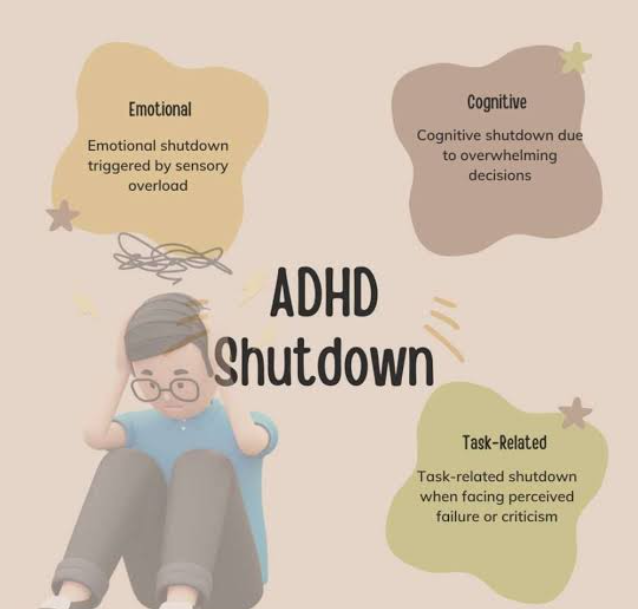
So the task is not really the problem. Your brain has gone offline for a moment while it copes with too much at once. Many people describe it like holding the keys to a car that simply will not start. The motivation is there, but the brain cannot organize the first step. That gap is why a simple task can suddenly feel impossible, and why you can badly want to move yet stay frozen. It is a real, recognized experience, not a lack of effort.
Did You Know? The body’s stress response has three modes, not two. Alongside fight and flight, the nervous system can freeze. ADHD shutdown is closely tied to that freeze mode, which is one reason willpower alone rarely switches it off.
Key Takeaways
- ADHD shutdown is a temporary freeze state, not laziness.
- Overwhelm overloads working memory and triggers the freeze response.
- It is widely recognized, though not a formal diagnosis on its own.
Signs You Are Entering ADHD Shutdown
Early signs of ADHD shutdown often include mental fog, a heavy or tired body, rising anxiety, and a strong pull to avoid or escape. Many people notice they start scrolling, freeze mid-thought, or feel unable to make even small decisions.
You might recognize some of these:
- Your thoughts feel slow, scattered, or blank.
- Simple choices suddenly feel exhausting.
- Your body feels heavy, tense, or hard to move.
- You feel a wave of dread about starting anything.
- You reach for your phone or a distraction without deciding to.
- You want to hide, nap, or leave the room.
Learning your own early signals matters. The sooner you notice a shutdown starting, the sooner you can respond with care instead of self-criticism.
What Causes ADHD Shutdown?
ADHD shutdown is usually caused by a mix of executive dysfunction and an overloaded nervous system. Common triggers include too many tasks at once, hard decisions, sensory overload, strong emotions, and ongoing stress. Any of these can push the brain past what it can process in the moment.
Several factors often stack together.
Overwhelm and decision fatigue. When you face many tasks or choices, the brain’s decision-making system tires quickly. This is called decision fatigue, and ADHD can make it arrive sooner.
Sensory overload. Noise, bright light, clutter, or busy spaces all demand extra processing. For a brain already working hard to focus, this can be the tipping point.
Emotional dysregulation. Many people with ADHD feel emotions intensely, and emotional regulation takes extra effort. A small stressor, like a critical email, can spark shame or frustration that floods the system and stalls action. Anxiety often makes this worse, since a worried mind adds to the load, and ADHD and anxiety frequently occur together.
The stress response. You have likely heard of “fight or flight.” There is a third response: freeze. When the brain reads a situation as too much, it can shut down movement and thinking as a form of protection.
Here is the pathway many people move through:
Overwhelm
↓
Working memory overload
↓
Stress response
↓
Freeze
↓
ADHD shutdown
↓
Recovery
None of this reflects a lack of willpower. ADHD also involves differences in dopamine, the brain chemical tied to motivation and reward, which can make starting low-interest tasks harder under stress. It reflects how the ADHD brain handles pressure, not how much you care.
ADHD Shutdown vs. Burnout, Procrastination, and Executive Dysfunction
ADHD shutdown, burnout, procrastination, and executive dysfunction are related but different. Shutdown is a short-term freeze from overwhelm. Burnout is longer-term exhaustion. Procrastination is delaying a task you can start. Executive dysfunction is the underlying difficulty with planning and task initiation that makes shutdown more likely.
These terms overlap, which is why they get confused. The tables below break down the differences.
ADHD Shutdown vs. Burnout
Feature | ADHD Shutdown | Burnout |
Timing | Sudden, in the moment | Builds over weeks or months |
Main cause | Acute overwhelm | Long-term, unrelenting stress |
Duration | Minutes to hours | Weeks to months |
Recovery | Reduce input, rest, reset | Sustained rest and real change |
ADHD Shutdown vs. Procrastination
Feature | ADHD Shutdown | Procrastination |
Ability to start | Cannot engage, even when willing | Can start but chooses to delay |
Feeling | Frozen, foggy, stuck | Distracted or unmotivated |
Root | Overwhelm and stress response | Task feels boring or unpleasant |
Control | Not a simple choice | More within conscious control |
ADHD Shutdown vs. Executive Dysfunction
Feature | ADHD Shutdown | Executive Dysfunction |
What it is | A temporary freeze state | An ongoing skill difficulty |
Scope | A specific episode | A daily, background challenge |
Relationship | A result of executive dysfunction under stress | The underlying difficulty itself |
Key Insight The simplest way to tell shutdown from procrastination: with procrastination you could start but put it off; with shutdown your brain cannot engage yet, even when you truly want to.
To go deeper on how this freeze shows up, our guide to the three types of ADHD paralysis breaks down mental, choice, and task paralysis.
How to Get Out of ADHD Shutdown
To recover from ADHD shutdown, lower the pressure on your brain first, then take one very small action. Reduce noise and stimulation, move your body, breathe slowly, and shrink the task to a single tiny step. Self-compassion, not force, is what helps the brain come back online.
ADHD Shutdown Recovery in 5 Simple Steps
If you need a quick version to follow in the moment, here is ADHD shutdown recovery, sometimes called ADHD freeze recovery, in five simple steps. These are a practical starting point for breaking ADHD paralysis and getting unstuck.
- Pause without judging yourself. Notice the freeze and name it calmly, such as “I am in a shutdown, and that is okay.” Self-criticism adds stress and makes the freeze worse, so start by easing the pressure on yourself.
- Reduce sensory overload. Lower the noise, dim the lights, or step into a quieter space. Less input gives your brain room to process, which is often the first thing that starts to thaw the freeze.
- Move your body for a minute. Stand, stretch, or take a short walk. Gentle movement releases some of the built-up stress energy and helps shift your body out of the frozen state.
- Complete one tiny task. Pick the smallest possible step, like opening a file or filling a glass of water. Finishing one small thing gives the brain a little momentum, and momentum tends to build.
- Ask for support if needed. Reach out to a friend, family member, or therapist, and if you are in Baltimore, a local licensed professional can help. You do not have to break out of shutdown alone.
The sections below expand on these steps and add more tools, grouped into calming the moment, adding outside support, and caring for the foundation.
First, calm the moment.
Pause without self-judgment. Fighting the freeze with frustration deepens it, while calmly naming it tells your nervous system you are safe, which lets the brain leave freeze.
Reduce stimulation. A quieter room, dimmer lights, or headphones mean less sensory input to process, which frees up capacity to act.
Move your body. Standing, stretching, or shaking out your hands releases stress energy and helps thaw a frozen state.
Breathe slowly. Make your exhale longer than your inhale for a minute or two. Slow breathing calms the stress response that feeds the shutdown.
Break the task into one tiny action. Do not aim to finish; opening the laptop or writing one sentence is enough. A single small step is easier for a stalled brain, and action builds on itself.
Next, add outside support.
Use external reminders and visual task lists. Working memory struggles under stress, so put the plan outside your head. A sticky note or checklist holds what your brain cannot right now.
Try body doubling. Working near another person, in the room or on a video call, adds quiet accountability that makes starting easier.
Use time blocking. Give one task a small, fixed window, such as ten minutes. A short, bounded effort feels safer than an open-ended one.
Finally, care for the foundation.
Protect your sleep, food, and water. Poor sleep, low blood sugar, and dehydration all drain your mental energy and shrink your capacity, which makes shutdowns more likely.
Reset your environment. A quick tidy of one surface, or a move to a calmer spot, lowers the sensory load behind overwhelm.
Practice mindfulness. Brief, regular check-ins with your body and breath build awareness of early warning signs, so you respond sooner.
Ask for support. You do not have to manage this alone. A trusted friend, family member, or therapist can help you plan, focus, or simply feel less stuck.
Know when to stop pushing. Sometimes the kindest and most effective choice is to rest and try again later. Forcing a frozen brain rarely works and often adds shame. Rest is a valid strategy, not a failure.
What Not to Do
The most common mistake during an ADHD shutdown is forcing yourself harder while piling on self-blame. Pressure and harsh self-talk raise stress, which deepens the freeze. Try to avoid adding more tasks, comparing yourself to others, or treating the moment as proof of failure.
A few things tend to backfire:
- Yelling at yourself to “just do it.”
- Trying to tackle the whole to-do list at once.
- Skipping meals, water, or sleep to power through.
- Doom-scrolling to escape, which often increases overwhelm.
Shutdown is not a character flaw. Meeting it with patience works far better than meeting it with punishment.
How Friends and Family Can Help
Friends and family help most by staying calm, patient, and non-judgmental. Offering to sit nearby, helping break a task into small steps, or gently reducing noise and pressure can ease a shutdown. Criticism and rushing usually make it worse.
If someone you love goes into shutdown, ask what would help rather than assuming. Offer to body double by staying in the room. Help them shrink the task to one step, and lower the stimulation around them. Above all, remind them that this is a brain state, not a moral failing. A steady, kind presence can be the very thing that helps them start moving again.
When to Seek Professional Support
Consider professional support when ADHD shutdown happens often, lasts a long time, or interferes with work, school, relationships, or daily life. A licensed mental health professional can help identify what is driving the pattern and build strategies that fit you.
Support can take several forms. A proper evaluation, such as ADHD testing, can clarify what you are dealing with. Therapy, including approaches like Cognitive Behavioral Therapy, can help with task initiation, emotional regulation, and self-compassion. ADHD coaching offers practical structure for planning and follow-through. For some people, ADHD medication management is part of the picture, though any medication decision should always be made with a qualified prescriber.
Because ADHD often occurs alongside anxiety, some people also benefit from anxiety therapy. For adults seeking ADHD support in Baltimore, the clinicians at Baltimore Counseling Center can help you understand your patterns and find a path forward. You can meet the team or reach out whenever you feel ready.
Common Myths About ADHD Shutdown
ADHD shutdown is widely misunderstood, and the myths around it often add shame that makes recovery harder. It is not laziness, it is not solved by willpower, and it does not look the same for everyone. Clearing up a few common misconceptions helps people respond with the right strategies instead of self-blame.
Myth: ADHD shutdown means you are lazy. Shutdown is a stress and executive function response, not a choice. The desire to act is usually there, but the brain cannot start. Laziness implies not caring, while people in shutdown often care a great deal and feel frustrated that they cannot move.
Myth: More willpower will fix it. Willpower cannot override a freeze response. Pushing harder tends to raise stress and deepen the shutdown. What helps is lowering the pressure, reducing input, and taking one small step, not forcing your way through.
Myth: ADHD shutdown and procrastination are the same thing. They can feel similar but differ at the root. With procrastination, you can start and choose to delay. In shutdown, the brain cannot engage yet, even when you truly want to. Treating one like the other leads to advice that does not work.
Myth: Only children experience ADHD shutdown. ADHD is a lifelong neurodevelopmental condition, and many adults experience shutdown too. Research suggests about half of adults with ADHD were first diagnosed as adults, so plenty of people meet this experience later in life, often at work or during busy seasons.
Myth: Medication instantly prevents shutdown. Medication can help some people manage ADHD symptoms, but it is not an on and off switch for shutdown, and it is not right for everyone. Skills like reducing overwhelm, steady sleep, and support still matter. Any medication choice should be made with a qualified prescriber.
Frequently Asked Questions
An ADHD shutdown often feels like being frozen in place while your mind goes foggy or blank. You may know exactly what needs doing, yet feel unable to start. Your body can feel heavy, small decisions can seem overwhelming, and you may feel an urge to hide or escape. Remember that this is a temporary brain state tied to overwhelm, not laziness.
ADHD shutdown is usually caused by the brain becoming overwhelmed beyond what it can process at once. Common triggers include too many tasks, hard decisions, sensory overload, intense emotions, and ongoing stress. These pressures strain executive function and working memory, the systems that help you plan and start tasks. The nervous system can then slip into a “freeze” stress response, and that combination is what leaves many people with ADHD stuck.
The length varies from person to person and situation to situation. Many shutdowns pass within minutes to a few hours once the pressure eases and the brain resets. Others can stretch across a day, especially after heavy stress or overstimulation. Reducing input, resting, moving your body, and taking one small step often help. If shutdowns last a long time or happen often, speak with a licensed professional.
Yes, many people manage ADHD and reduce shutdowns without medication, though the right approach differs for everyone. Non-medication strategies include therapy, ADHD coaching, mindfulness, exercise, better sleep, and tools like reminders and time blocking. For some people, medication also helps, and many find a combination works best. The key is to work with a qualified professional, and to never change medication without guidance from your prescriber.
ADHD shutdown and burnout are related but not the same. Shutdown is a sudden, short-term freeze triggered by overwhelm in the moment, and it often eases within minutes to hours. Burnout is a slower, deeper exhaustion that builds over weeks or months of unrelenting stress and needs sustained rest to recover. Shutdown responds to reducing input and small steps, while burnout calls for bigger changes to workload and boundaries. Repeated shutdowns can add up to burnout over time.
This article is educational and is not a substitute for personalized medical advice, diagnosis, or treatment. ADHD, ADHD shutdown, and related experiences affect everyone differently. If you are struggling, please speak with a licensed mental health professional who can offer care based on your specific situation.
Moving Forward
ADHD shutdown is a real, common experience, not a personal failing. It happens when an overwhelmed ADHD brain slips into a “freeze” state, driven by executive dysfunction, sensory overload, strong emotions, and stress. The way out is not force. It is lowering the pressure, taking one small step, and treating yourself with patience. If you take away three things, let them be these: shutdown is not laziness, self-compassion works better than force, and small steps are how a stalled brain starts moving. Recovering from ADHD shutdown, and from the executive dysfunction and overwhelm beneath it, is a skill you can build over time.
If ADHD shutdown, overwhelming stress, or executive functioning challenges keep getting in your way, you do not have to figure it out alone. The team at Baltimore Counseling Center supports adults across Baltimore, Maryland with ADHD testing, therapy, coaching, and medication management, all in a calm and judgment-free space. When you feel ready, reaching out can be the first small step toward feeling more in control.
