

Unipolar depression is commonly used to refer to major depressive disorder (MDD), in contrast to depressive episodes that occur as part of bipolar disorder. It involves depressive episodes without a history of qualifying mania or hypomania. Bipolar depression is the depressive phase of bipolar disorder, a condition in which the person has also experienced at least one manic or hypomanic episode at some point in their life.
Here is the part that surprises most people: during a low period, the two can look and feel very similar. The difference is usually not in the depression itself. It is in what else has happened across the person’s lifetime.
This is why a depressive episode on its own does not establish which condition someone has. A mental health professional considers the broader picture: the pattern of mood over months and years, previous periods of unusually elevated mood or energy, family history, and other medical and medication factors.
One clarification worth making early, because it causes a lot of confusion online: “bipolar depression” is not a separate diagnosis. It is a way of describing when a depressive episode happens. If depression occurs in someone who has bipolar disorder, it is bipolar depression. The diagnosis is bipolar disorder.
Bipolar Depression vs. Unipolar Depression at a Glance
Feature | Unipolar Depression (MDD) | Bipolar Depression |
What it is | A depressive disorder in its own right | The depressive phase of bipolar disorder |
Depressive episodes | Yes | Yes |
Mania or hypomania | No qualifying manic or hypomanic episode identified in the person’s history | A qualifying manic or hypomanic episode identified at some point in the person’s history |
Mood pattern over time | Depressive episodes without a history of qualifying mania or hypomania | Depressive episodes occurring within bipolar disorder, alongside a history of qualifying mania or hypomania |
Energy and activity | Reduced during depressive episodes | Reduced during depressive episodes, and noticeably increased during manic or hypomanic periods |
Sleep changes | Sleeping too little or too much during depressive episodes | The same during depressive episodes, and periods of reduced need for sleep during manic or hypomanic episodes |
What the person may notice first | The depression | Often also the depression, which is one reason the two can be confused |
Key diagnostic distinction | Assessed as MDD when no qualifying manic or hypomanic episode is identified during a broader clinical evaluation | Assessed as bipolar disorder when a qualifying manic or hypomanic episode is identified during a broader clinical evaluation |
Treatment planning | May involve psychotherapy, medication, or a combination, depending on the person | Considers the broader bipolar condition and the person’s history of depressive, manic, and hypomanic episodes |
What Is Unipolar Depression?
Unipolar depression is the clinical shorthand for major depressive disorder. “Unipolar” refers to mood moving in one direction, downward, rather than shifting between two poles.
Under DSM-5 criteria, a major depressive episode involves symptoms present most of the day, nearly every day, for at least two weeks, representing a change from previous functioning. The American Psychiatric Association describes symptoms that can include:
- Feeling sad, irritable, empty, or hopeless
- Loss of interest or pleasure in activities that used to matter
- Significant change in appetite or weight
- Sleeping too little or too much
- Decreased energy or increased tiredness
- Restlessness, or slowed movement and speech noticeable to others
- Feeling worthless or excessively guilty
- Difficulty thinking, concentrating, or making decisions
- Thoughts of death or suicide
A clinician may also consider medical conditions, medications, and substance use that can cause or worsen depression-like symptoms. Physical examination or laboratory testing may be used where appropriate to help rule out other causes.
What Is Bipolar Depression?
Bipolar depression is the depressive phase of bipolar disorder. The depressive symptoms themselves can closely resemble those of major depressive disorder.
What makes it bipolar depression is the surrounding condition. Bipolar disorder involves distinct mood episodes, including depressive episodes and episodes of mania or hypomania, with changes in mood, energy, activity, and behavior. NIMH notes that in between episodes, mood usually returns to a healthy baseline.
So a person in a bipolar depressive episode is not experiencing a different kind of sadness. They are experiencing depression within a condition that can also produce periods of elevated or irritable mood.

The Biggest Difference: Mania and Hypomania
What is mania?
A manic episode is a distinct period of abnormally and persistently elevated, expansive, or irritable mood, together with abnormally increased activity or energy, representing a clear departure from the person’s usual self.
NIMH describes symptoms of a manic episode as including feeling very up, high, elated, extremely irritable, or touchy; feeling jumpy or wired, or being more active than usual; racing thoughts; decreased need for sleep; talking fast about a lot of different things; excessive appetite for food, drink, sex, or other pleasurable activities; feeling able to do many things at once without getting tired; feeling unusually important, talented, or powerful; and difficulty maintaining work responsibilities, social activities, or relationships.
Under DSM-5 criteria, a manic episode lasts at least seven consecutive days, or requires hospitalization. NIMH similarly describes Bipolar I disorder as defined by manic episodes lasting at least seven days, most of the day and nearly every day, or by manic symptoms severe enough that hospital care is needed.
What is hypomania?
Hypomania involves the same kinds of symptoms in a less severe form. Under DSM-5 criteria, a hypomanic episode lasts at least four consecutive days. The distinguishing feature is severity rather than symptom type: a hypomanic episode is not severe enough to cause marked impairment in social or occupational functioning, and does not require hospitalization. If psychotic features are present, the episode is considered manic by definition.
Here is what can make hypomania easy to miss. NIMH puts it directly: hypomanic episodes may make an individual feel very good and productive, and they may not feel like anything is wrong. Family and friends, however, may notice the mood swings and changes in activity levels as unusual behavior.
That gap between how it feels from the inside and how it looks from the outside is central to why bipolar depression can be mistaken for unipolar depression.
A note on caution: reading these lists and recognizing yourself in a few items does not mean you have bipolar disorder. Ordinary good moods, periods of high motivation, and short bursts of energy are part of normal life. What clinicians look for is a sustained, distinct change from a person’s own baseline that other people could observe. That is not a judgment to make from a webpage.
Can Bipolar Depression Look Like Unipolar Depression?
Yes, and understanding why is more useful than any symptom list.
The depressive episodes overlap substantially. Low mood, loss of interest, sleep disruption, fatigue, and difficulty concentrating can appear in both. Because the depressive symptoms themselves often look so similar, current symptoms alone may not be enough to distinguish MDD from bipolar depression.
People tend to seek help during the lows, not the highs. This is the crux of it. NIMH notes that people with Bipolar II disorder may seek help only for depressive episodes, and that hypomanic episodes may go unnoticed. Depression is painful and prompts action. A period of feeling energized, capable, and needing less sleep rarely prompts anyone to book an appointment. So a clinician may see the depression and never hear about the high unless someone thinks to ask about it, or the person thinks to mention it.
The highs may not be remembered as a problem. Someone might describe a past hypomanic period as “a really productive spring” or “the time I finally got my life together.” It may not get filed mentally as a symptom, so it may not get reported as one.
Other people may have noticed it first. Someone close to you may remember a stretch where you were talking faster, sleeping very little, taking on too much, or unusually irritable, during a period you remember as feeling fine.
Which is why the timeline can matter more than the moment. NIMH advises that to avoid misdiagnosis, it is important to consider the course of the disorder over the past days and weeks rather than focusing solely on current symptoms. A single depressive episode, examined in isolation, may not answer the question. The pattern over time often can.
How Do Clinicians Distinguish Bipolar Depression From Unipolar Depression?
There is no single blood test or brain scan that establishes a diagnosis of bipolar disorder. Medical tests may still be used to help rule out other conditions that can cause similar symptoms. NIMH notes that a health care provider may complete a physical exam, order medical testing to rule out other illnesses, and refer the person for an evaluation by a mental health professional, and that bipolar disorder is diagnosed based on the severity, length, and frequency of an individual’s symptoms and experiences over their lifetime, and their family history.
The list below is educational information about what a clinical assessment may cover. It is not a self-diagnosis checklist and is not designed to be scored. It is offered so that you know what kind of conversation to expect and what information may be useful to bring.
An assessment may consider:
- Current symptoms and how long they have lasted
- Previous mood episodes, including any period of elevated, expansive, or irritable mood
- Changes in energy and activity that represented a clear shift from the person’s usual self
- Periods of reduced need for sleep, where the person felt rested on far less sleep than normal
- Speech and thought changes, such as talking noticeably faster or racing thoughts
- Impulsive or risky behavior during periods of increased energy
- Family history of mood disorders
- Medications, alcohol, and other substances. NIMH notes that the effects of some prescribed, recreational, or illicit drugs can sometimes mimic or worsen mood symptoms.
- Medical factors. NIMH notes that some health conditions, such as thyroid disease, can cause symptoms like those of bipolar disorder.
- How symptoms have affected functioning at work, at home, and in relationships
- Observations from people close to the person, where the person consents to that
No single item on this list decides anything on its own. A clinician weighs the overall picture, and may revisit it as more of a person’s history becomes clear.
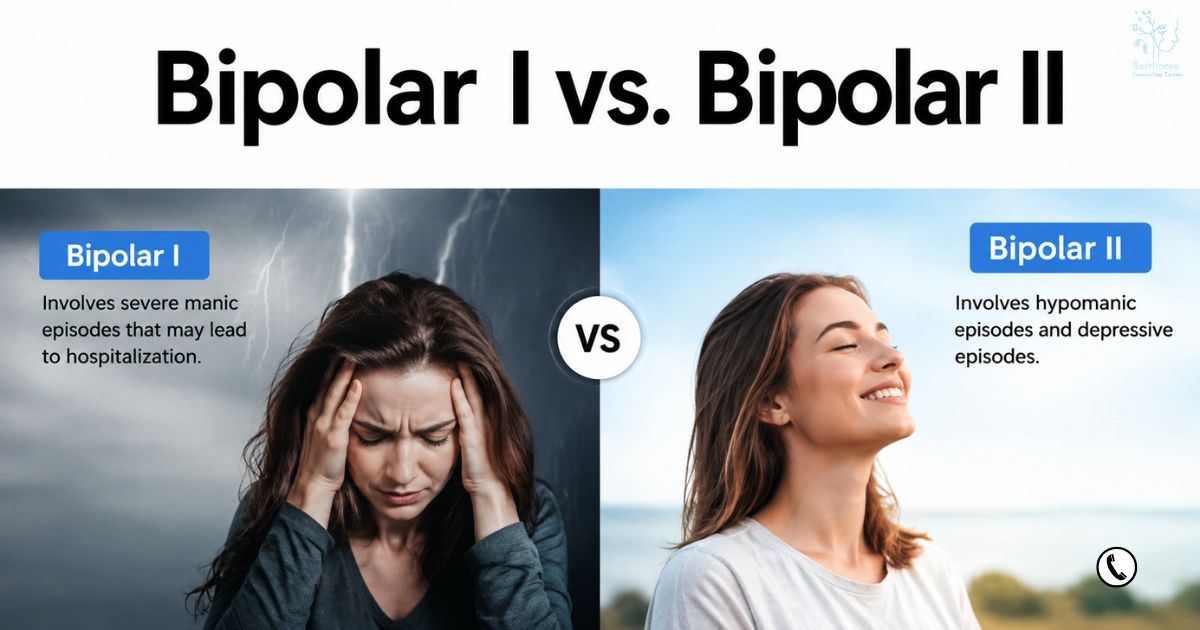
Bipolar I vs. Bipolar II
Both are forms of bipolar disorder, and both can involve depression.
Bipolar I disorder requires at least one manic episode. NIMH describes it as defined by manic episodes lasting at least seven days, most of the day and nearly every day, or manic symptoms severe enough that hospital care is needed. Separate depressive episodes usually occur as well, typically lasting at least two weeks, though under DSM-5 criteria a depressive episode is not required for the diagnosis.
Bipolar II disorder is defined by a pattern of depressive episodes and hypomanic episodes, where the hypomanic episodes are less severe than the manic episodes seen in Bipolar I. Under DSM-5 criteria, the diagnosis requires at least one hypomanic episode and at least one major depressive episode, with no manic episodes.
A common misreading is that Bipolar II is simply “milder.” That is not what the distinction means. The highs are less severe, but NIMH notes that many people with Bipolar II disorder spend extended periods in a persistent, low-grade depressive state. The depressive burden can be substantial and long-lasting.
There is also a third form, cyclothymic disorder, which NIMH defines by recurrent hypomanic and depressive symptoms that are not intense enough or do not last long enough to qualify as hypomanic or depressive episodes.
How Treatment Can Differ
Treatment is individual. Nothing here is advice about any particular person’s care, and treatment decisions belong with a qualified prescribing clinician who knows your history.
For unipolar depression, treatment may involve psychotherapy, medication, or a combination, depending on the person’s circumstances.
For bipolar disorder, treatment planning considers the broader bipolar condition and the person’s overall history of depressive, manic, and hypomanic episodes, rather than the current depressive episode alone. NIMH notes that bipolar depression may be treated with a mood stabilizer or an atypical antipsychotic, with an antidepressant added in some cases. NIMH also notes that antidepressants are not used alone in bipolar disorder because they can trigger a manic episode or rapid cycling.
There is meaningful overlap between the two. Psychotherapy has a role in both, and NIMH notes that some types of psychotherapy can be effective for bipolar disorder when used alongside medication. What differs is the framework within which treatment decisions are made.
Why Getting the Diagnosis Right Matters
The distinction is not a labeling exercise. It shapes what a treatment plan is designed to do.
Treatment for major depressive disorder generally aims to address depressive episodes and reduce the likelihood of future ones. Treatment planning for bipolar disorder also accounts for manic or hypomanic episodes, which means it is oriented toward longer-term mood stability rather than the current low alone.
NIMH notes that antidepressants are not used alone in bipolar disorder because they can trigger a manic episode or rapid cycling. This is one reason clinicians consider a person’s broader mood history when developing a treatment plan.
There is a practical takeaway in that. If your current treatment is not helping the way you and your clinician expected, that is a useful thing to raise at your next appointment rather than something to wait out. It is not a reason to stop or change any medication on your own.
When Should You Talk With a Mental Health Professional?
None of the following means that someone has bipolar disorder. These are situations where a conversation with a professional may be worthwhile.
- Depressive symptoms have lasted two weeks or longer
- Symptoms are interfering with work, relationships, or daily functioning
- There have been significant changes in mood, energy, or activity level that felt unlike your usual self
- There have been periods of unusually reduced need for sleep, where you felt rested on very little
- There were periods of increased energy during which you behaved impulsively or took risks that seem out of character in hindsight
- Someone close to you has described a past period of your behavior in a way that does not match how you remember it
- You have a depression diagnosis but are not sure whether your full mood history was ever discussed
- Your current treatment is not helping the way you and your clinician expected
You do not need to wait two weeks to seek help. The two-week mark relates to how a depressive episode is defined, not to when it is appropriate to reach out. If symptoms are severe, worsening quickly, or you are having thoughts of suicide or self-harm, seek support now.
If you or someone you know is struggling or having thoughts of suicide, you can call or text the 988 Suicide & Crisis Lifeline at 988, or chat online at 988lifeline.org. It is free, confidential, and available 24/7. In a life-threatening emergency, call 911.
Questions to Ask a Mental Health Professional
These are worth writing down beforehand. Depression can make recall difficult, and appointments are short.
- Could my depressive symptoms be part of bipolar disorder rather than major depressive disorder?
- Have I described anything that could be relevant to mania or hypomania?
- What information about my mood history over the years would be most useful for you to have?
- Would it help if I brought someone who has known me for a long time?
- Could my medications, alcohol use, or another medical condition be affecting my symptoms?
- Given my diagnosis, what treatment options are appropriate, and how will we know whether it is working?
- What should I tell you about if my mood or energy changes between appointments?
One preparation step that can help: before an appointment, make a rough timeline of periods when you felt depressed, unusually energized, needed less sleep, or noticed major changes in your behavior. It does not need to be exact. The goal is simply to help you describe the overall pattern.
Frequently Asked Questions
No, though the depressive symptoms can be very similar. Major depressive disorder involves depressive episodes with no history of mania or hypomania. Bipolar depression is a depressive episode occurring within bipolar disorder, where a manic or hypomanic episode is part of the person’s history.
Yes. NIMH notes that some people have bipolar disorder for years before it is diagnosed, partly because people with Bipolar II disorder may seek help only for depressive episodes while hypomanic episodes go unnoticed.
The key diagnostic distinction is whether a person has experienced a qualifying manic or hypomanic episode as part of their broader mood history. A clinician considers this alongside the person’s other symptoms, history, and overall clinical picture rather than treating it as a single yes-or-no question.
Yes. NIMH notes that many people with Bipolar II disorder spend extended periods in a persistent, low-grade depressive state. Depression can dominate the experience of the condition.
Through clinical evaluation. NIMH describes diagnosis as based on the severity, length, and frequency of symptoms and experiences over a person’s lifetime, together with family history. A provider may also complete a physical exam and order medical testing to help rule out other illnesses.
Bipolar I disorder requires at least one manic episode, which NIMH describes as lasting at least seven days or being severe enough to require hospital care. Bipolar II disorder involves hypomanic episodes, which are less severe than mania, alongside major depressive episodes.
Treatment planning differs because it accounts for manic or hypomanic episodes, not the depressive episode alone. NIMH notes that bipolar depression may be treated with a mood stabilizer or an atypical antipsychotic, with an antidepressant added in some cases, and that antidepressants are not used alone in bipolar disorder because they can trigger mania or rapid cycling.
A person is not generally given both diagnoses to explain the same mood episodes. If a clinician identifies a qualifying history of mania or hypomania, bipolar disorder may be diagnosed rather than MDD. Clinical literature notes that a diagnosis can be revised over time when additional history becomes known. This is a clinical judgment rather than something to determine from an article.
Key Takeaways
- Unipolar depression means major depressive disorder: depressive episodes with no history of mania or hypomania.
- Bipolar depression is the depressive phase of bipolar disorder. It is not a separate diagnosis in itself.
- During a low period, the two can look very similar. Because the depressive symptoms overlap substantially, current symptoms alone may not be enough to tell them apart.
- The key diagnostic distinction is whether a qualifying manic or hypomanic episode is identified in the person’s broader mood history, as part of a full clinical assessment.
- Hypomania can be easy to miss from the inside. NIMH notes it can make a person feel very good and productive, while family and friends may be the ones who notice the change.
- Clinicians consider the pattern of mood over a lifetime, along with family history, medical factors, and substances, rather than the current episode alone.
- The distinction matters because it shapes treatment planning. NIMH notes that antidepressants are not used alone in bipolar disorder because they can trigger mania or rapid cycling.
- If you have a depression diagnosis and are unsure whether your full mood history was considered, that is a reasonable thing to raise with your clinician.
If you are in the Baltimore area and want to discuss your mood history with a mental health professional, Baltimore Counseling Center provides therapy and medication management for adults, with telehealth options available.
