
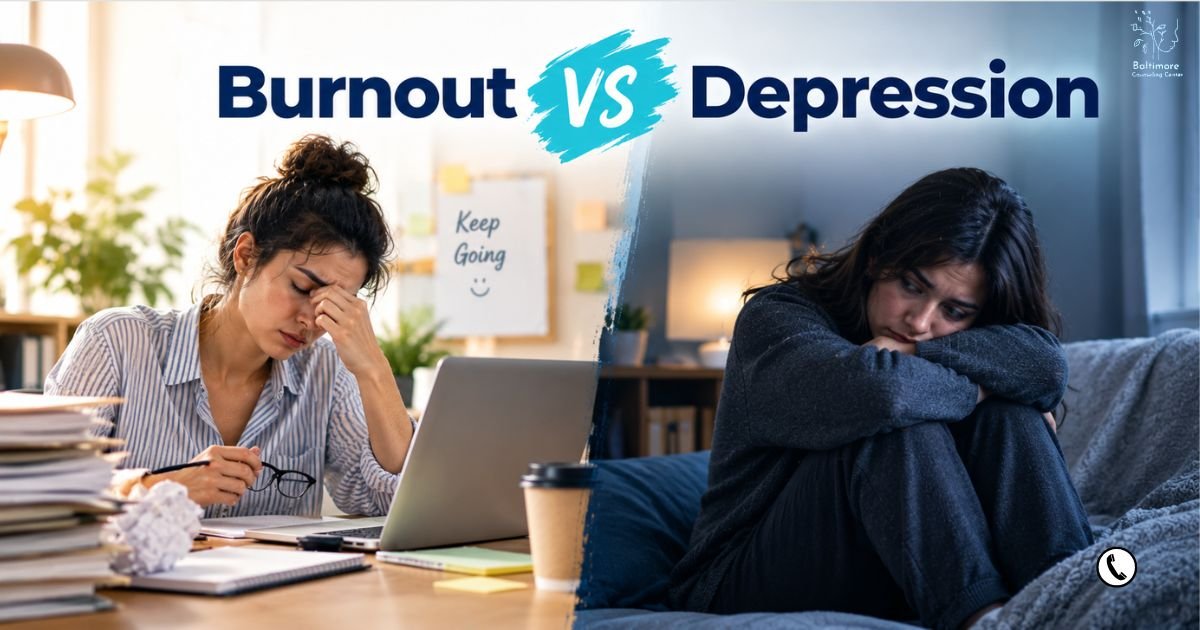
You wake up tired after a full night’s sleep. Small tasks feel heavy, your focus drifts, and things that used to roll off your back now make you snap. Many people in this spot say they are “burned out,” and sometimes that is right. But exhaustion, poor concentration, sleep trouble, and irritability can also show up with depression.
People often reach for the word burnout first. It seems to come with a clear cause, usually a job or a heavy load, and it can feel easier to say out loud than depression. This guide explains where the two overlap, where they tend to differ, and when it makes sense to talk with a professional.
What is the difference between burnout and depression? Burnout and depression can feel alike, but they usually differ in scope. The World Health Organization describes burnout as an occupational phenomenon linked to chronic workplace stress that has not been successfully managed. Depression is a mental health condition that tends to affect mood, energy, and interest across most areas of life.
Important: This article is for general education only. It is not medical advice, diagnosis, or treatment. If you are thinking about suicide or harming yourself, call or text 988 in the US right away, or call 911 in an emergency.
Key takeaways
- Burnout and depression share experiences like exhaustion, trouble focusing, sleep problems, and irritability.
- The World Health Organization describes burnout as an occupational phenomenon, not a medical condition. Depression is a recognized mental health condition.
- A useful general difference is scope: one main source of stress, or most areas of life.
- The two can happen together. Research links them but has not shown that one causes the other.
- Only a licensed professional can assess what is going on. If you are thinking about suicide, call or text 988.
Burnout vs depression at a glance
Burnout | Depression | |
Main source/scope | Usually one main source of stress, most often work | Most areas of life, not just one setting |
What happens with rest or time away | Often eases somewhat with real distance from the source, though not always | Often changes little with a break |
Enjoyment outside the source of stress | Often still possible away from the stress | Loss of interest or pleasure in many activities is common |
View of yourself | Doubt tied to the role, such as “I’m failing at this job” | Can involve broader feelings of worthlessness or guilt |
Sleep | Can be disrupted around periods of stress | Changes are common, including sleeping much less or much more |
Concentration | Often hardest on tasks linked to the stress | Trouble focusing can show up across daily life |
How long it tends to last | Often follows how long the stress continues | Can last weeks or longer, even when circumstances change |
These are general patterns, not a way to diagnose yourself.
What is burnout?
The World Health Organization (WHO) includes burnout in the 11th Revision of the International Classification of Diseases (ICD-11) as an occupational phenomenon. WHO says burnout is “not classified as a medical condition.” It appears in a chapter covering reasons people may contact health services that are not illnesses or health conditions.
WHO describes burnout as resulting from chronic workplace stress that has not been successfully managed. It has three dimensions:
- Feeling depleted of energy or exhausted
- Feeling mentally distant from your job, or negative and cynical about it
- Feeling less effective at work
WHO also notes that the term refers specifically to the work context. We come back to that in the section on burnout beyond the office.
Source: World Health Organization, Burn-out an occupational phenomenon
What is depression?
The National Institute of Mental Health (NIMH) explains that depression, also called major depressive disorder or clinical depression, is different from the everyday sadness that tends to pass with time. It can cause serious symptoms that affect how a person feels, thinks, and handles daily activities.
NIMH describes depression as one of the most common mental disorders in the United States, and notes that it is a risk factor for suicidal thoughts and behaviors.
This article does not list diagnostic criteria and cannot tell you whether you have depression. Only a licensed professional can assess that.
Source: National Institute of Mental Health, Depression
Where burnout and depression overlap
Can burnout mimic depression? In many ways, yes. The two can feel very similar from the inside. Experiences that can show up with either one include:
- Exhaustion that rest does not seem to fix
- Trouble concentrating or making decisions
- Sleep problems
- Irritability or a shorter fuse than usual
- Feeling numb, flat, or detached
- Low motivation
None of these points to one or the other on its own. Where differences exist, they tend to show up as patterns over time: where the feelings appear, how they respond to change, and how long they last.
Five differences that can help tell them apart
These are general patterns, not rules, and they can overlap in the same person.
1. Scope: one part of your life, or all of it?
Burnout usually centers on one main source of stress, most often work. Depression tends to spread across most areas of life, including relationships, hobbies, and downtime. The emotional tone often differs too: burnout is commonly described as frustration, cynicism, and depletion, while depression more often involves persistent low mood or hopelessness.
2. Rest and time away
Burnout often eases at least somewhat when a person gets real distance from the source of stress, such as time off or a lighter workload. Depression more often lingers regardless of a break. This is a general pattern and a clue only. It is not proof of either, and it does not work the same way for everyone.
A short break may be too brief to show any change, and some burnout lingers even with time off. If tiredness stays the same no matter how much you rest, our guide to signs your depression may need professional help looks at that experience more closely.
3. Enjoyment and interest
People with burnout often still enjoy things away from the source of stress, like a weekend activity, a hobby, or time with friends. Depression more often involves a broader loss of interest or pleasure, sometimes called anhedonia, that reaches most activities, including ones a person used to love.
The useful question is where the loss shows up: mainly in one role, or almost everywhere. Our 9 signs guide covers what a broader loss of enjoyment can look like.
4. How you see yourself
With burnout, self-doubt is often tied to a role, such as feeling ineffective at a job or overwhelmed as a caregiver. Depression can involve broader feelings of worthlessness or guilt about who a person is, not just how one role is going. These are general patterns, not a way to judge yourself.
Burnout might sound like “I’m not good at this job anymore.” Depression might sound more like “I’m not good, period.” Neither is a personal failing.
5. How long it lasts
Burnout tends to follow the stress behind it, building while the pressure continues and often easing when the situation changes. Depression can persist for weeks or longer, even when circumstances improve. If low mood, exhaustion, or loss of interest has lasted for weeks and seems to be spreading, that is a reason to talk with a professional.
Noting how you feel over a few weeks can show whether your feelings move with your circumstances or stay put.
Can burnout and depression happen at the same time?
Yes. Burnout and depression can co-occur, and having one does not rule out the other.
A 2019 systematic review and meta-analysis in Frontiers in Psychology found a moderate correlation between burnout and depression (r = 0.52). The authors concluded the two are more likely to be different constructs than the same thing. They also noted that research has not established which one causes the other.
So, can burnout turn into depression? Research shows a link, not proof of cause. What is worth watching is change: exhaustion that starts in one role and spreads into evenings, weekends, and relationships.
Source: Koutsimani, Montgomery & Georganta (2019), Frontiers in Psychology
Burnout beyond the office
The WHO definition of burnout is specific to work. Terms like “caregiver burnout” and “parental burnout” are broader, everyday uses of the word. They describe real exhaustion, but they are not the same as the WHO definition.
You may still hear the word used for experiences like these:
- Caregivers: an adult caring for a parent or partner with a long-term illness
- Parents: a parent worn down by constant demands, with little time to recover
- Students: a student facing heavy coursework and deadlines
The same patterns can still help: does the exhaustion stay with one role, and can you still enjoy time away from it? The point is to describe what is happening, not to pick a label.
Common myths
Myth: “Burnout is just a softer word for depression.” They are different concepts. WHO describes burnout as an occupational phenomenon, while depression is a recognized mental health condition. They can overlap, but one is not a nicer name for the other.
Myth: “A vacation fixes depression.” Depression often continues regardless of a break. Feeling better on vacation does not rule depression out, and feeling the same does not prove it. Rest is one clue, never a test.
Myth: “If you can still go to work, it cannot be depression.” Many people keep showing up to work, school, or caregiving while struggling inside. Getting through the day does not mean everything is fine.
Myth: “Burnout is a medical diagnosis.” WHO includes burnout in ICD-11 as an occupational phenomenon and states it is not classified as a medical condition. That does not make burnout less real or less worth addressing.
Questions to reflect on (this is not a test)
This is not a test and it cannot tell you what you have. There is no score and no result. These questions may simply help you put your experience into words, for yourself or for a professional.
- Where do I notice the exhaustion most: in one role, or almost everywhere?
- When I get real time away from my main source of stress, does anything feel different, even a little?
- Are there still things I look forward to or enjoy?
- When I am hard on myself, is it about how one part of my life is going, or about who I am?
- How long have I felt this way, and has it been changing?
- Has this started to affect my sleep, my relationships, or how I get through the day?
When to get help right away
If you or someone you know is having thoughts of suicide or self-harm, get help now:
- Call or text 988 to reach the 988 Suicide & Crisis Lifeline in the US. You can also chat at 988lifeline.org.
- Call 911 if someone is in immediate danger.
- Go to the nearest emergency room if it is not safe to wait.
When you call 988 from a Maryland area code, your call is routed based on your area code to a Maryland call center. If that center cannot answer, the call goes to a national backup center.
Outside of an emergency, talking to a licensed professional is a reasonable general next step when exhaustion, low mood, or loss of interest lasts for weeks, spreads beyond one role, or makes daily life hard to manage.
Talking to a counselor in Baltimore
Baltimore Counseling Center offers in-person sessions at 703 Dale Ave, Baltimore, MD 21206, as well as online therapy sessions for clients who prefer to meet virtually.
You do not need to know whether it is burnout, depression, or both before reaching out. Sorting that out is part of an assessment with a licensed professional.
To learn more first, you can read about depression therapy in Baltimore at our center, or see 9 signs your depression needs professional help.
Frequently asked questions
What is the difference between burnout and depression?
Is burnout a form of depression?
Is burnout a medical diagnosis?
Can you be burned out and depressed at the same time?
Can burnout turn into depression?
Does burnout only happen at work?
Moving forward
Burnout and depression can feel almost identical, and they can happen together. One general question can help: is this mostly about one part of your life, or has it spread to most of it? You do not have to answer it alone.
If you are in the Baltimore area, book an appointment with Baltimore Counseling Center.
This article is for general education only and is not medical advice, diagnosis, or treatment. If you are thinking about suicide or harming yourself, call or text 988, or call 911 in an emergency.
