
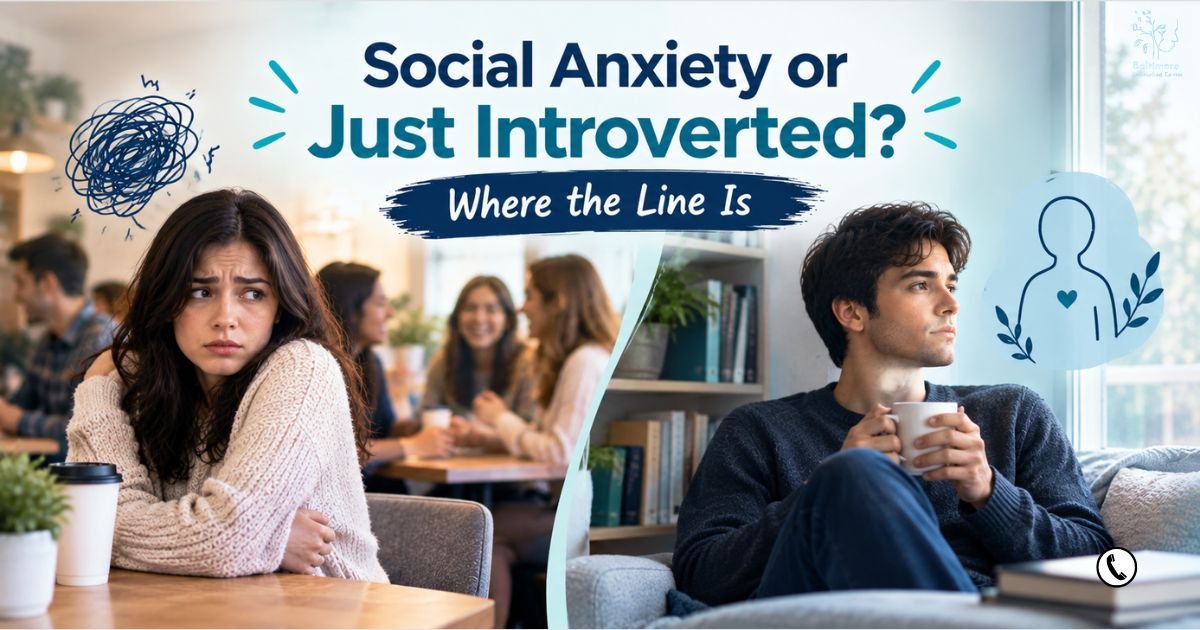
Am I introverted or socially anxious?” Many people ask this quietly, often after skipping one more party. From the outside, both can look the same. You leave early, turn down plans, or stay quiet in a group.
In everyday terms, the line in social anxiety vs introversion comes down to energy versus fear. Introversion is a personality trait about where you get your energy, so time alone feels restoring. Social anxiety centers on fear of being judged or rejected, so stepping back feels more like escape than rest.
Many people are both. This guide explains the difference in plain language, with everyday examples and questions to reflect on. It does not offer a diagnosis.
Disclaimer: This article is for general education only. It is not medical advice, diagnosis, or treatment. If you want support for your own situation, talk to a licensed professional. If you are in crisis, call or text 988 in the US.
Key takeaways
- Introversion is an energy trait. Introversion is a normal personality trait, not a mental health condition. Introverts often recharge with time alone.
- Social anxiety is a fear experience. Social anxiety centers on worry about being judged, embarrassed, or rejected by others.
- You can be both. One person can be introverted and socially anxious. Extroverts can experience social anxiety too.
- Introversion needs no fixing. Preferring quiet, small groups, or time alone is a normal way of being, not a flaw.
- The useful question is about motive. Instead of “which label fits me?”, ask “is energy or fear making this choice?
What does introversion feel like?
Introversion often feels like having a social battery that drains in busy settings and refills with quiet. Introversion is a personality trait, not a mental health condition. Introverts can enjoy people and still need time alone, or time in calm and familiar settings, to restore their energy afterward.
According to Mental Health America (MHA), introverts get their energy from within. Busy social settings are not necessarily frightening for them. Those settings simply take more energy.
Introversion sits on a spectrum with extroversion, and Healthline notes that most introverts still enjoy time with friends. Healthline also points out that learning new social skills can help you feel more relaxed in groups, but it does not change how you get your energy.
People often describe introversion like this:
- Feeling worn out after a long event, even one that went well
- Looking forward to quiet time once plans are over
- Preferring one-on-one time or small groups to big crowds
- Enjoying a party for a while, then wanting to leave once energy runs low
A clinician writing for the National Social Anxiety Center (NSAC) describes introversion as one part of basic temperament: what feels natural to you, rather than what feels like work.
What does social anxiety feel like in everyday terms?
Social anxiety, in everyday terms, feels like a strong fear of being judged, embarrassed, or rejected by other people. Social anxiety can show up as dread before an event, self-consciousness during it, and replaying conversations afterward. People often want to join in but feel held back by worry.
The National Institute of Mental Health (NIMH) describes fear that centers on being watched, evaluated, or judged in ordinary situations, like meeting new people or asking for help. NIMH also describes worry that can start well before an event, and a habit of going back over interactions afterward to look for flaws.
A key detail is wanting. Healthline and MHA both describe people who would like to join the group but hold back because they worry about how they will be received.
Alone time can also feel different. MHA explains that for people with social anxiety, time alone may bring temporary relief from worry, but it does not leave them feeling recharged.
A note on this section: This is a general description of how people often describe the experience. It is not a checklist. Recognizing yourself in parts of it does not tell you what you are experiencing. Only a licensed professional who knows your situation can help with that.
Social anxiety vs introversion: what is the difference at a glance?
The difference between introversion and social anxiety is what drives the step back. Introversion is an energy trait, so introverts step back to recharge. Social anxiety is a fear experience, so people step back to escape worry about judgment. The behavior can look identical, so the reason behind it matters most.
Introversion | Social anxiety | |
What it is | A normal personality trait about energy and preference | An experience of fear centered on being judged or rejected |
What drives stepping back | The need to restore energy | The wish to avoid feared judgment or embarrassment |
How alone time feels | Restoring and often enjoyable | Often a relief from worry, but not truly restful |
How skipping an event feels | Usually fine, or a small trade-off | Relief mixed with regret, especially if you wanted to go |
Does it need fixing? | No | It is not a flaw either. If fear keeps getting in the way, support is available. |
Table sources: MHA, Healthline, NSAC.
MHA adds a helpful contrast. When missing an event would mean missing something meaningful, introverts can often find the motivation to go. People with social anxiety may cancel plans even when they truly want to attend.
How do introversion, shyness, and social anxiety compare?
Shyness is usually a milder discomfort around new people or situations that often eases as you get comfortable. Introversion is about energy and preference, not fear. Social anxiety involves a more intense and persistent fear of judgment. The three can overlap, but having one does not mean having the others.
The shyness vs social anxiety question is mostly about intensity and staying power. Healthline notes that shyness often fades once you feel welcome, and that many people lean toward shyness or introversion without social anxiety.
Shyness | Introversion | Social anxiety | |
Core idea | Mild, situational discomfort | Energy and preference | More intense fear of being judged |
How it often feels | Hesitant or self-conscious with new people | Comfortable socially, then drained afterward | Dread, self-consciousness, replaying |
With familiarity | Often eases as you feel welcome | Familiar settings may feel easier, but the need to recharge stays | Fear can continue through an event, even with people you like |
Is it a flaw? | No | No | No. Support is available if it gets in the way. |
Table sources: Healthline, MHA.
Can you be both introverted and socially anxious?
Yes, an introvert can also have social anxiety. Introversion and social anxiety are separate things, so one person can need quiet time to recharge and also fear being judged. Extroverts can experience social anxiety too. The useful question is whether energy or fear is driving a particular choice.
The NSAC makes three points here. Introverts and extroverts alike may experience social anxiety. Not all introverts are socially anxious. And socially anxious extroverts sometimes withdraw, which can lead others to mistake them for introverts.
Healthline also notes that people near the extroverted end of the spectrum can have social anxiety.
Picture one evening. You leave a friend’s dinner at 9 because you feel tired and want quiet. That is energy. On the drive home, you replay a joke that fell flat and worry what everyone thought. That is fear. Both can show up in the same person, on the same night.
MHA frames it this way: if you spend time alone not just to recharge, but because you worry how others will react to you, that part is worth paying attention to.
Where is the line in everyday settings?
The line between introversion and social anxiety often shows up in small, everyday moments. The same action, like staying quiet or leaving early, can come from low energy or from fear. The examples below are patterns to notice, not verdicts. None of them can tell you what you are experiencing.
This is where the introvert vs social anxiety question gets practical. In each moment, notice the reason behind the choice.
- A work meeting. Energy pattern: You stay quiet because you like to think before speaking, then share ideas later by email. Fear pattern: You have something to say but stay silent because you worry it will sound wrong, then think about it for hours.
- A group chat. Energy pattern: You mute it for an evening because constant messages feel tiring. Fear pattern: You type and delete a reply several times, or worry you upset someone when a friend does not reply.
- A phone call. Energy pattern: You prefer texting because calls feel draining. Fear pattern: You let calls go to voicemail because you dread saying something awkward.
- A family gathering. Energy pattern: You enjoy it, then plan a quiet morning afterward to recharge. Fear pattern: You dread it for days, feel watched while you are there, and replay conversations afterward.
- Your first day somewhere new. Energy pattern: It feels tiring, and you look forward to being home. Fear pattern: The worry about being judged stays strong, even after people start to feel familiar.
Many people see themselves in both patterns. That is common. It is not a score, and it is not a result.
What are common myths about introversion and social anxiety?
The most common myths treat introversion as a problem and social anxiety as simple shyness. Introversion is a normal personality trait. Social anxiety is a separate experience centered on fear. Here are five myths and what general sources say instead.
- Myth: Introverts are rude, antisocial, or need fixing. Introversion is a personality trait, not a mental health condition, according to MHA. MHA also notes that introverts are generally open to new people on their own terms. Preferring quiet is not rudeness, and it does not need fixing.
- Myth: Social anxiety is just shyness. Shyness often eases as you feel comfortable, while social anxiety tends to involve stronger fear of judgment, as Healthline explains. NIMH also treats the two as different.
- Myth: Social anxiety is extreme introversion. MHA states that social anxiety is not just an extreme form of introversion. Introversion relates to energy. Social anxiety relates to fear.
- Myth: Extroverts cannot have social anxiety. Introverts and extroverts alike can experience social anxiety, according to the NSAC.
- Myth: Talking to a therapist means being pushed to become outgoing. Introversion is part of who you are, and Healthline notes that new skills do not change how you get your energy. A clinician writing for the NSAC argues that trying to turn introverts into extroverts is the wrong goal. Support for social anxiety is about fear, not personality.
Reflection prompts: what is shaping your choices?
These reflection prompts are a gentle way to notice whether energy or fear is shaping your social choices. This is not a test. No score. Just questions to think about. There are no right answers, and your responses do not point to any label.
- Does time alone leave you feeling restored, or mainly relieved to be away from worry?
- Is fear making choices for you lately?
- When you skip an event, do you feel at peace with it, or do you wish you had gone?
- After a conversation, do you move on fairly quickly, or replay it looking for mistakes?
- If you knew no one would judge you, would you choose differently?
When should you consider talking to someone?
You could consider talking to someone if fear keeps getting in the way of things you want, like friendships, work, or events you would enjoy. You do not need a certain level of distress or a label first. A conversation can simply help you sort out what is going on.
In general terms, NIMH suggests seeking professional help when anxiety starts causing problems in everyday life, and notes that a primary care provider is one place to start. Healthline adds that support can make a real difference when fear keeps you from the connections you want.
If you are in the Baltimore area, you can learn about anxiety therapy in Baltimore at Baltimore Counseling Center.
Does introversion need to be treated?
No, introversion does not need to be treated. Introversion is a normal personality trait, not a mental health condition. If you enjoy your quiet time and feel fine about your social life, there is nothing to change. Support is about fear that gets in the way, not about personality.
MHA describes downtime to recharge as important self-care for introverts.
Getting support in Baltimore
Baltimore Counseling Center offers anxiety therapy from its office at 703 Dale Ave, Baltimore, MD 21206. The center describes personalized plans, a safe and confidential space, and flexible scheduling that includes evening and weekend appointments. Remote therapy sessions are also available for people who prefer not to come in.
- Address: 703 Dale Ave, Baltimore, MD 21206
- Learn more: anxiety therapy at Baltimore Counseling Center
- Remote sessions: Available. Contact the center to check whether remote sessions are offered where you live.
Frequently asked questions
Can introverts have social anxiety?
Can extroverts have social anxiety?
Is being introverted a mental health condition?
Why do I replay conversations in my head afterward?
Is it normal to prefer being alone?
So, is it introversion or social anxiety?
Methodology note: This post is general educational content. It contains no clinical information, no diagnosis, and no treatment recommendation.
