
Important: This article is for general education only. It is not medical advice, diagnosis, or treatment. If you are unsure about chest pain or other symptoms, seek emergency care promptly or call 911. If you are in crisis, call or text 988 in the US. Talk to a licensed professional about your own situation.
Your heart is racing, your chest feels tight, and afterward you’re left wondering what just happened. Was it a panic attack? An anxiety attack? Are those even different things?
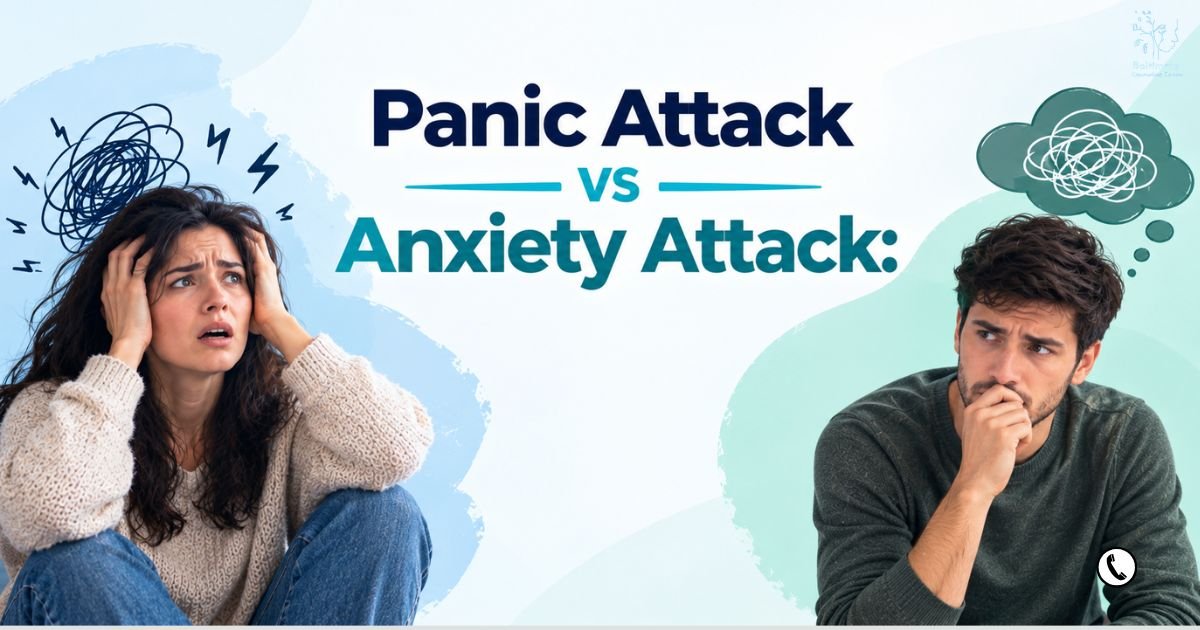
The panic attack vs anxiety attack question confuses a lot of people, because the two phrases get used as if they mean the same thing. This guide explains the difference in plain language.
The short answer: A panic attack is a recognized clinical term. NIMH describes it as a sudden wave of fear or discomfort that can happen even without a clear trigger. “Anxiety attack” is everyday language, not a formal diagnosis. People usually use it for anxiety that builds over time around a worry or stressor.
Panic attack or heart attack? Read this first.
Panic attacks and heart attacks can share symptoms, including chest pain, shortness of breath, and a racing heart. Nobody can reliably tell them apart from symptoms alone, and this article can’t either.
If chest pain or pressure is new, unfamiliar, or severe, or you are unsure what is happening, seek emergency care promptly or call 911. Let a medical professional rule out heart causes. The American Heart Association advises: “Even if you’re not sure it’s a heart attack, get checked out.”
Heart attack warning signs listed by the AHA and the CDC include:
- Chest pain, pressure, or discomfort
- Pain or discomfort in one or both arms or shoulders, the back, neck, jaw, or stomach
- Shortness of breath, with or without chest discomfort
- Breaking out in a cold sweat, nausea, or feeling lightheaded or faint
- Unusual tiredness (the CDC notes women are more likely to have symptoms such as unexplained tiredness and nausea or vomiting)
If you are in emotional crisis, call or text 988 or chat at 988lifeline.org. The 988 Lifeline is free, confidential, and available 24/7.
Key takeaways
- A panic attack is a sudden wave of intense fear or discomfort with physical symptoms such as a racing heart, sweating, and trouble breathing, according to NIMH.
- “Anxiety attack” is not a formal diagnosis. People often use the phrase for anxiety that builds gradually around a worry or stressor.
- One panic attack is not the same as panic disorder. NIMH describes panic disorder as repeated, unexpected panic attacks plus at least a month of ongoing worry about them or changes in behavior to avoid them.
- Chest pain can come from panic or from the heart. If chest pain is new, severe, or unclear, call 911 and let a medical professional rule out heart causes.
- Cognitive behavioral therapy (CBT) and gradual exposure are widely used approaches for panic and anxiety, according to NIMH and the American Psychiatric Association. A licensed professional can help decide what fits a specific person.
Is "anxiety attack" a real medical term?
“Anxiety attack” is a common everyday phrase, but it is not a formal clinical term. Clinical sources such as NIMH and the American Psychiatric Association (APA) describe panic attacks and anxiety disorders. The APA’s patient guide to anxiety disorders does not list “anxiety attack” as a category. The feelings people describe with the phrase are still real.
The APA’s guide, What are Anxiety Disorders?, uses “panic attack” throughout and never uses “anxiety attack.” Someone who says “anxiety attack” may be describing a panic attack, a stretch of intense worry, or a mix of both. A licensed professional can help sort out which description fits.
What is actually happening in your body?
Panic and anxiety both involve the body’s threat-response system, but in different ways. According to the APA, fear is a response to an immediate threat and is tied to the “fight-or-flight” response. Anxiety is the anticipation of a future concern. The APA says it is more often tied to muscle tension and avoidance.
A panic attack can feel like that fight-or-flight alarm going off with no clear danger in sight. NIMH notes that panic attacks can happen even without a clear danger or trigger. NIMH also says some researchers view panic attacks as “false alarms.”
The exact causes are still being studied. According to NIMH, panic disorder sometimes runs in families. NIMH also says several brain regions and biological processes may play a role, and that researchers are looking at stress and environmental factors too.
Panic attack vs anxiety attack: a side-by-side comparison
The clearest difference between a panic attack and what people call an anxiety attack is speed and intensity. A panic attack is a sudden surge of intense fear, which ADAA says peaks in 10 minutes or less. What people call an “anxiety attack” usually builds more gradually around a worry or stressor and has no formal definition.
This table compares two experiences. It does not compare diagnoses.
Panic attack | “Anxiety attack” | |
Clinical status | Everyday phrase, not a formal diagnosis | |
How it starts | Suddenly, sometimes with no clear trigger (NIMH) | Often builds gradually, usually around a worry or stressor |
Peak and length | Peaks in 10 minutes or less (ADAA). Can last from a few minutes to an hour or longer (NIMH) | No standard length, because the phrase has no formal definition |
Intensity | Intense fear with strong physical symptoms (NIMH) | Often described as less intense but longer lasting |
Common sensations | Pounding or racing heart, sweating, trembling, trouble breathing, chest pain, a feeling of losing control (NIMH) | Worry, restlessness, muscle tension, trouble concentrating (overlaps with anxiety symptoms NIMH lists) |
Panic attack, anxiety attack, or panic disorder: what's the difference?
A panic attack is a single episode, and “anxiety attack” is an informal name for an episode of intense anxiety. Panic disorder and generalized anxiety disorder (GAD) are different. They are conditions that a licensed professional diagnoses based on patterns over time. One difficult moment is not enough to diagnose either one.
Term | Episode or condition? | What the source says |
Panic attack | Episode | A sudden wave of fear or discomfort, sometimes without a clear trigger (NIMH) |
“Anxiety attack” | Informal name for an episode | No formal clinical definition |
Panic disorder | Condition | Recurrent, unexpected panic attacks, plus at least one month of worrying about more attacks, being frightened by what they mean, or changing behavior to avoid them (NIMH) |
Generalized anxiety disorder (GAD) | Condition | Trouble controlling worry on most days for at least 6 months, plus at least three symptoms such as restlessness, fatigue, trouble concentrating, irritability, muscle tension, or sleep problems (NIMH) |
Having one panic attack does not by itself mean someone has panic disorder. Feeling anxious during a stressful week does not by itself mean someone has GAD. Only a licensed professional can diagnose either condition. This table is for understanding the terms, not for self-diagnosis.
What do panic attacks and anxiety attacks feel like?
Panic attacks and anxiety attacks can share physical sensations, because both involve the body’s stress response. Panic attacks tend to hit hard and fast. What people call anxiety attacks is usually described as slower and more drawn out. ADAA notes that panic attacks can happen when a person is calm or already anxious.
What does a panic attack feel like?
A panic attack often feels like a sudden alarm going off in the body. NIMH lists emotional symptoms such as overwhelming fear, a feeling of losing control, and a fear of death or impending doom. NIMH also lists physical symptoms that can include:
- A pounding or racing heart
- Sweating, chills, or trembling
- Trouble breathing
- Weakness or dizziness
- Tingling or numbness in the hands
- Chest pain
- Stomach pain or nausea
These sensations can be frightening. According to NIMH, panic attacks themselves are not life-threatening, and the physical symptoms usually pass with time. Chest pain can also signal a heart problem, so the safety guidance at the top of this article still applies.
What does an anxiety attack feel like?
What people call an anxiety attack is often described as a rising wave of worry and tension rather than a sudden spike. The phrase has no formal definition, so there is no official symptom list. The sensations people describe often overlap with anxiety symptoms that NIMH lists, such as restlessness, irritability, muscle tension, and trouble concentrating.
In its guide to generalized anxiety disorder, NIMH also lists physical complaints such as headaches, muscle aches, stomach problems, sweating, lightheadedness, and shortness of breath. Having some of these sensations does not mean a person has GAD. They are listed here only to describe what anxiety can feel like in the body.
Why can panic attacks seem to come out of nowhere, or at night?
Panic attacks can seem to come out of nowhere because, according to NIMH, they can happen even without a clear danger or trigger. NIMH also notes that panic attacks can occur at any time, sometimes even during sleep. ADAA similarly notes that attacks can happen when someone is waking up from sleep.
Why this happens isn’t fully understood. NIMH says researchers are studying brain regions, biological processes, stress, and environmental factors. Waking up in panic can be especially frightening. It’s a reasonable thing to bring up with a doctor or therapist, who can also check for other possible causes.
Panic attack or heart attack? How to think about chest pain
Chest pain during a suspected panic attack should never be self-diagnosed. NIMH notes that a panic attack can feel like a heart attack. ADAA says panic symptoms can mimic heart disease, which leads many people to seek emergency care. If chest pain is new, severe, or unclear, call 911 and let a medical professional rule out heart causes.
Getting checked is not an overreaction. The APA says the first step is often seeing a doctor to rule out medical conditions that can cause similar symptoms. NIMH notes that a provider may do a physical exam for the same reason. Once heart causes have been ruled out, a person and their care team can talk about whether panic or anxiety is part of the picture.
For the warning signs of a heart attack, see the safety box at the top of this article, based on the AHA and CDC.
What can help in the moment?
Coping skills such as slow, paced breathing and grounding can help some people ride out a wave of panic or anxiety. These are coping tools, not cures. NIMH describes relaxation and breathing training as skills that may be taught alongside therapy. The APA lists mindfulness and relaxation practices as helpful self-management habits.
General steps some people find useful:
- Put safety first. If you have chest pain or are unsure what is happening, call 911 before trying anything else.
- Name the experience. If you have been through panic before and a doctor has ruled out other causes, it can help to tell yourself what this feels like and that it has passed before.
- Slow your breathing. Breathe in gently and let the out-breath be a little longer and slower.
- Ground your attention. Notice a few things you can see, hear, and touch around you, one at a time.
- Give it time. Stay where you are if it is safe, and give one technique a few minutes before switching to another.
- Make a note afterward. Jot down when it happened and what you were doing. This can be useful to share with a doctor or therapist.
If panic or anxiety keeps coming back, coping skills alone may not be enough. Talking with a licensed professional can help.
How can you help someone having a panic attack?
Helping someone through a panic attack usually starts with staying calm and staying with them. Speak in short, simple sentences, ask what they need instead of guessing, and offer to breathe slowly with them. If they have chest pain or you are unsure whether it is a medical emergency, call 911.
Other general tips, adapted from NAMI’s HelpLine guidance:
- Ask what has helped them before. If they can’t say, offer one option and let them choose.
- Try one technique at a time and give it a few minutes to work.
- Remember that some people prefer moving, stretching, or focusing on their surroundings over breathing exercises.
- Afterward, acknowledge how hard that was and thank them for letting you help.
- If they are in emotional crisis, they can call or text 988, which is free, confidential, and available 24/7.
What does therapy for panic and anxiety generally involve?
Therapy for panic and anxiety generally focuses on understanding the cycle of fear and building skills to respond to it differently. According to NIMH and the APA, cognitive behavioral therapy (CBT) and gradual exposure are widely used approaches. Mindfulness practices are often part of the mix. What fits any one person is something to decide with a licensed professional.
Cognitive behavioral therapy (CBT)
CBT is a structured, skills-focused type of talk therapy. The APA says CBT helps people change unhelpful thought patterns, build coping skills, and gradually face feared situations. NIMH calls CBT the “gold standard” psychotherapy for panic disorder. NIMH says it teaches new ways of thinking, behaving, and reacting to anxious feelings.
NIMH says this can help make panic attacks less frequent. Results differ from person to person, and no approach works the same way for everyone.
Gradual exposure therapy
Exposure therapy means slowly and safely facing feared situations or sensations with a therapist’s support, rather than avoiding them. NIMH describes exposure therapy as a way to help people face activities they have been avoiding. NIMH notes it may be combined with relaxation and breathing training.
NIMH also mentions interoceptive exposure. In this approach, a person practices, in a structured way, with the body sensations linked to panic.
Mindfulness practices
Mindfulness practices involve paying attention to the present moment, including thoughts and body sensations, without judging them. The APA lists mindfulness and relaxation practices as self-management habits for anxiety. NIMH says acceptance and commitment therapy (ACT), which uses mindfulness, has growing research support for GAD.
According to NIMH, medication is another option some people discuss with a prescribing provider. Medication decisions belong with a qualified prescriber, so this article does not cover them.
How this looks at Baltimore Counseling Center
At Baltimore Counseling Center, anxiety therapy may blend CBT, mindfulness practices, and exposure therapy when applicable. Each person’s therapy plan is personalized, and sessions take place in a safe, confidential space. Progress looks different for different people, and a therapist can explain what to expect in their own approach.
Myths about panic and anxiety attacks
Several common beliefs about panic and anxiety attacks don’t match what clinical sources describe. Clearing them up can make it easier to understand what is happening and to know when to ask for help. Here are four that come up often, along with what NIMH, ADAA, and the APA actually say.
Myth: “It’s just stress.” Stress and panic can be connected. Still, NIMH notes that a panic attack can happen even without a clear trigger. The APA describes everyday stress as situational and short-lived. It describes anxiety that is persistent, interfering, or overwhelming as a possible sign to look into further.
Myth: “One panic attack means you have panic disorder.” A single panic attack is not a diagnosis. NIMH describes panic disorder as repeated, unexpected attacks plus at least a month of ongoing worry about them or changes in behavior to avoid them.
Myth: “Breathing into a paper bag fixes it.” None of the clinical sources used for this article (NIMH, APA, ADAA) recommend paper-bag breathing. NIMH describes breathing training as a skill that may be taught as part of treatment. Chest tightness or breathlessness can also have medical causes, so getting checked matters more than any home remedy.
Myth: “Avoiding triggers is the solution.” Avoiding triggers can seem like the obvious answer. However, NIMH lists avoiding places where attacks have happened as a sign of panic disorder. NIMH describes exposure therapy as a way to help people face what they have been avoiding.
When should you consider talking to a therapist?
It may be worth talking with a therapist if panic or anxiety attacks keep coming back, if worry about the next attack is shaping your days, or if you have started avoiding places or activities. These are common reasons people reach out, not a diagnosis. A licensed professional can help sort out what is going on.
Some people reach out when they notice:
- Panic attacks that keep returning, sometimes without warning (NIMH)
- Ongoing worry about having another attack, or about what the attacks mean (NIMH)
- Avoiding places, activities, or situations where an attack happened before (NIMH)
- Worry that feels hard to control on most days (NIMH)
- Anxiety that feels persistent or overwhelming, or that gets in the way of work, relationships, or sleep (APA)
Nobody needs to match any of these points to ask for help. Wanting to understand what is happening is reason enough. If you are in the Baltimore area, you can read about anxiety therapy in Baltimore to see how the process works.
If you are in crisis, call or text 988 at any time.
Getting help for panic attacks in Baltimore
If you are in Baltimore and want support with panic or anxiety, Baltimore Counseling Center offers anxiety therapy at 703 Dale Ave, Baltimore, MD 21206. Therapy plans are personalized and can draw on CBT, mindfulness practices, and exposure therapy when applicable. Evening and weekend appointments and remote therapy sessions are available.
- Location: 703 Dale Ave, Baltimore, MD 21206
- Session options: In-person sessions at the office, or remote therapy sessions
- Scheduling: Flexible, including evening and weekend appointments
- Learn more: Anxiety therapy at Baltimore Counseling Center
- Phone: (443) 266-5533
You can find out more about the practice on the Baltimore Counseling Center homepage. Booking details are at the end of this article.
Frequently asked questions
How long does a panic attack last?
Is an anxiety attack the same as a panic attack?
Does having a panic attack mean I have panic disorder?
Can anxiety turn into a panic attack?
Are panic attacks dangerous?
The bottom line
Panic attacks and anxiety attacks can feel similar, but they are not the same thing. A panic attack is a sudden, intense episode with a clinical definition. “Anxiety attack” is everyday language for anxiety that usually builds more slowly.
Neither one is a diagnosis on its own, and chest pain always deserves a medical check first. If panic or anxiety keeps showing up in your life, talking with a licensed professional is a reasonable next step.
Next step: Learn how anxiety therapy at Baltimore Counseling Center works, or book an appointment online.
Important: This article is for general education only. It is not medical advice, diagnosis, or treatment. If you are unsure about chest pain or other symptoms, seek emergency care promptly or call 911. If you are in crisis, call or text 988 in the US. Talk to a licensed professional about your own situation.
